5 Years of Pain

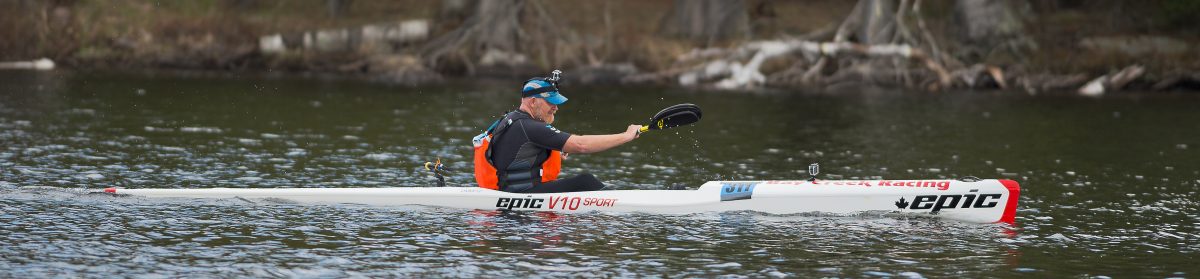
So a little under 5 years ago, I was taking a paddle and I had a pain in the area of my left sit bone so bad I had to stop paddling, get out of the boat, do some stretches, and continue on. The previous year had been lockdown and in spite of the fact that I only had one race that year I had been training hard and working on Strava segment CRs and virtual races. But 2021 was going to be my best year ever, and so I started out the year with a bang. Most years I had been lucky to get more than a few 10 mile plus paddles in before the Round the Mountain race, but this year I’d started out with a plan to really ramp up my mileage, and maybe take a shot at the 90 Miler the following year. So there I was, a month to go before the race season started, and I was already doing 25-30 kilometer long paddles. And feeling an annoying nagging pain. I was also doing 3-4 hour long bike rides on days I wasn’t paddling.

The pain kept increasing as the season went on, but rather than cutting back on training, I kept going. I did end up having an amazingly good season, in spite of the fact that towards the end of the season I would need to push my butt out of the seat for a few seconds to get some momentary relief, then continue on. I couldn’t wait for the end of the season, and when it finished I put my boat away and didn’t touch it until much later than I usually start the following year. And when I did, I went for an easy paddle but was in agony after 15 minutes, and spent another 30 minutes getting back to the dock because I had to keep stopping because it hurt too much. Much later in the year I discovered that with a thermarest pad placed exactly right, I could stand slightly longer paddles, but with much reduced stability so I only paddled my more stable boat on the most wave free segment of the canal.

Now the problem with the sit bone area of your body is that there’s a lot going on there. Basically near your sit bone (your Ischial Tuberosity), you’ve got a bunch of muscles anchored there, like your Performis, and your Quadralatis, as well as your Sciatic nerve, your Hamstring tendon, and there’s a Ischial Bursa there as well. So during the last 5 years I’ve had a lot of conflicting diagnoses, a lot of different therapies, and a lot of medical interventions.

As an aside, is there such a thing as being immune to cortisone shots? I’ve had a bunch of them over the years, including in my knee, in my shoulder, in my carpal tunnel, and in the last 5 years, in various nerves and tendons etc. And I’ve never gotten a smidgen of relief from any of them. The closest I’ve gotten is sometimes an hour of relief from the anesthetic they inject before the cortisone.

Anyway, after trying everything from stretching routines to spinal implants, my local pain doctor suggested I need an Ischial Bursectomy. I asked him who could do it, and he cut and pasted a Google search into an email and sent it to me. Basically no local doctor does it. And if you do the search, you find several doctors around the country whose websites say they do it, but when you contact them they say they don’t do it any more. Oh, and maybe a few doctor’s offices who think you’re saying something different – I didn’t catch on until a few of them said “we only do hip operations”. I tried saying it like “iskeal” to see if that helped with the understanding.

Eventually I found one doctor on Park Avenue in New York who, when you call to ask, the front desk says “sure, we do it” and makes an appointment, but when you fly down there at great personal expense, the doctor says that they don’t do it, but have you thought about PRP? To say I was pissed off at his clinic was an understatement. Ok, I had thought about it, but it seems pretty dubious, since all it is is that they take some blood out, centrifuge it down, and inject parts of it back into you. There’s a similar therapy going around but instead of your blood platelets, they inject sugar or something like that. I think the theory behind both of them is to stimulate an immune/inflamation reaction. But I did know that one of the doctors I’d used in Rochester does PRP, so I went back and tried that, and it was ineffectual. (Oh, and not covered by medical insurance.)

Eventually somebody on Reddit’s r/ChronicPain subreddit got in touch with me to say that they’d had an Ischial Bursectomy from a Doctor Harris in Houston and it had done them a world of good. So I got in touch with Doctor Harris’s office and after jumping through a lot of hoops I got an appointment to fly down there so he could examine me. And he agreed to do the procedure! I was so happy! Doctor Harris exudes confidence and healing.

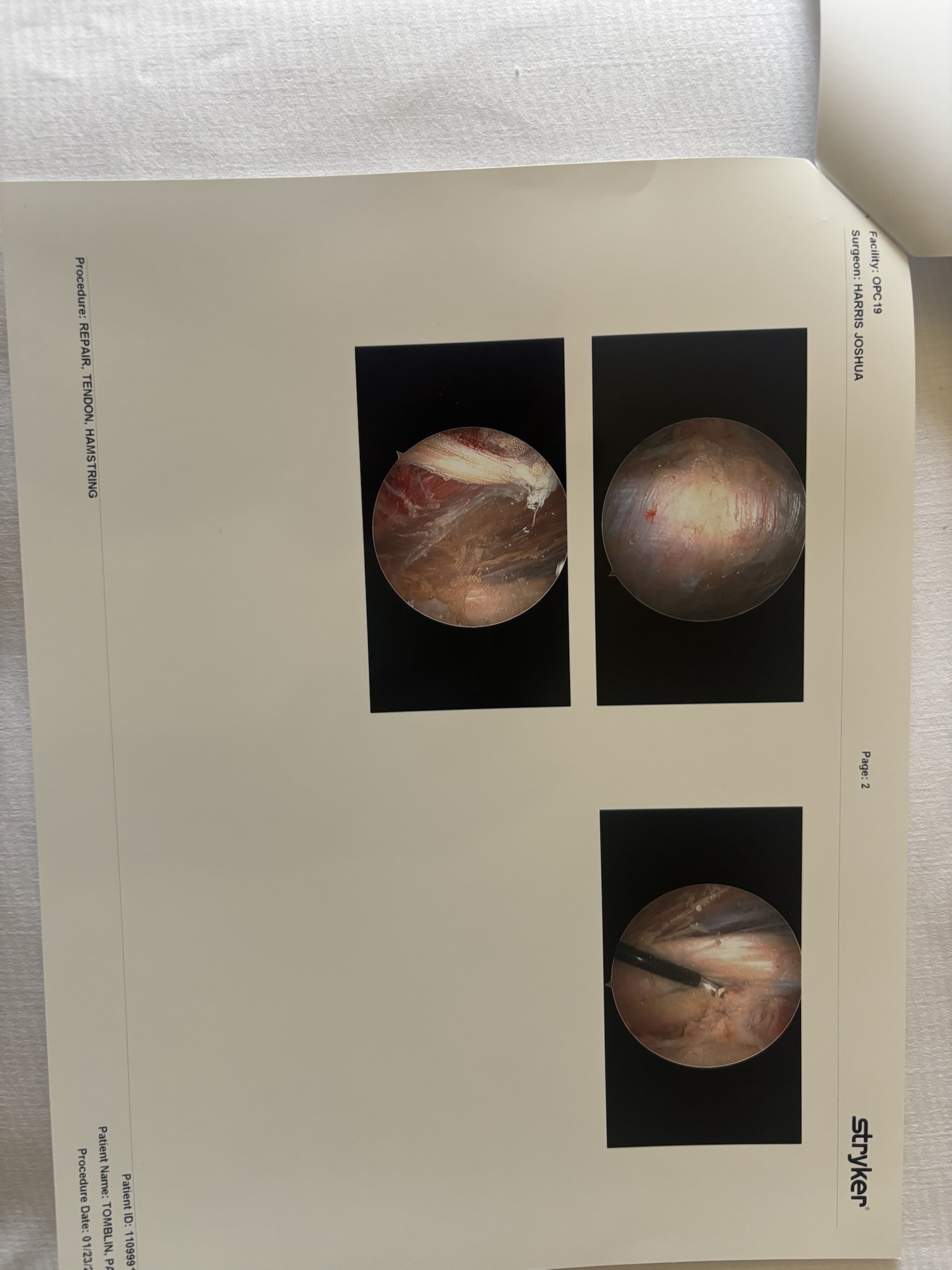
So eight days ago, I went under the knife (or the arthroscope) and got exactly what I’d spent the last couple of years dreaming about. He gave me some photos taken through the arthroscope, showing all these fibers growing out of my bursa and preventing my sciatic nerve and my posterior femoral cutaneous (PFC) nerve from moving the way they’re supposed to be. And after photos showing the bursa gone, the fibers gone, and both nerves free of entanglements. He said that in normal conditions, that bursa is about 1mm thick, but mine was swollen up to about 6mm. He also said that while he was in there, he was moving my leg around and practically had me doing the splits to make sure there was no impingement between the bones in there, which can be a problem. No wonder orthopedic surgeons look so fit, when they have to move my fat ass around like that.
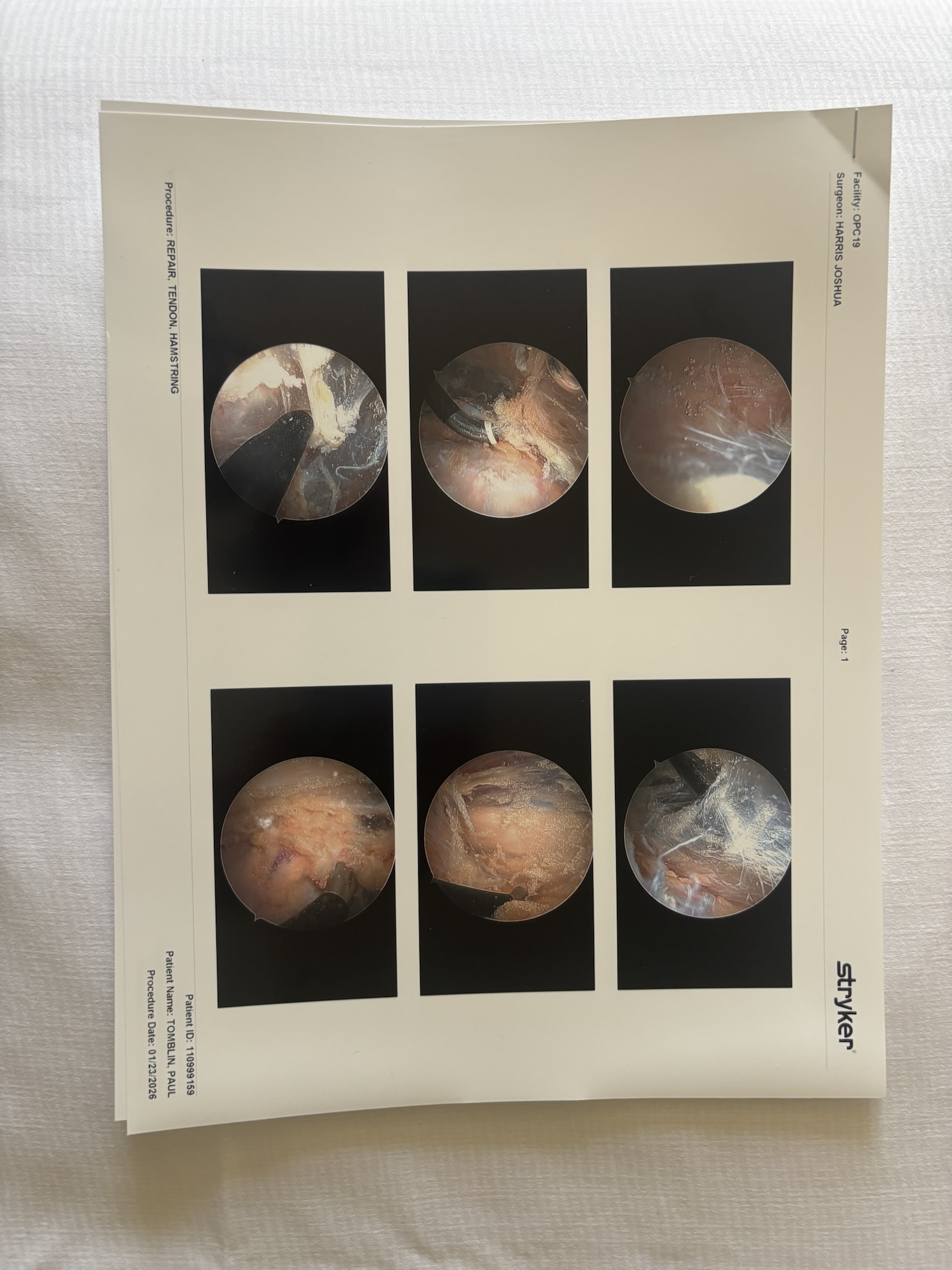
What a mess!
Nerves all clean and moving

So like I said, it’s been 8 days and of course I’ve got post-op pain. It’s really hard to judge whether the pain I’m feeling right now is the same old pain from the last 5 years, or it’s because somebody inserted a metal object and stared scraping away parts of my body. But considering that a lot of the pain I’m feeling is from different places than the old pain, I’m hopeful. I think the doctor suggested I might not know for sure how much difference it has made until 5 weeks go by, so I’m trying to be patient about this. And mostly succeeding, but not 100%.

Oh one other thing – Doctor Harris suggested I get a DEXA bone density scan because he felt my sit bone was a little soft. How shit would it be after all this to find out that the pain was actually my sit bone collapsing under the pressure of sitting on it 18 hours a day?

So where do we go from here? Well, I promised myself a new camera to celebrate this milestone. The question I’m waiting to find out is do I buy a new drone (the Avata 360 when it comes out) for filming other people’s kayak races, or do I buy an action camera (the Insta360 X5) to mount on my kayak for filming my own.

Obviously I’m hoping for a return to kayaking, but I’m thinking I’m not going to be as fanatic about it – no more 6 days of kayak work outs and a 4 hour bike ride on the off day. I believe that piling on more and more workouts didn’t really improve my speed that much any way. Plus it’d be hard to maintain a consistent workout regime when I’m trying to do more with Vicki. I think the goal now will be to get in such workouts as I can, go to races when I can, but work them in around my life instead of working my life in around the kayaking.

And what if the surgery didn’t fix the problems? Well, then life will be pretty much like it’s been for the last year – RV trips with the “rule of 3”, and videoing some kayak races. It’s not awesome, but it’s good enough to tide me over until I find the next thing to try.

The rule of three is “travel no more than 3 hours a day, get to your destination by 3pm, and spend 3 days at each campground”. We’ve kind of modified it to have a couple of 3 hour days in a row before recovering my pain levels by having a 3 day or more stay at a campground. But we’ve been thinking about longer trips, like across the country, and there’s no way we’d want to do that unless we can manage a few 5+ hour days between the major stops. Doing it 3 hours at a time would take more than a whole summer.

Drone My Roof Part 3

As I wrote about in Drone My Roof and Drone My Roof Part 2, I was getting my roof redone at great expense, and I was determined to get a good time lapse of the whole process. As I said in Part 2, I made a circular waypoint track. At semi-regular intervals I went out and flew it twice. My intention was that for each time I flew, I’d use some non-integer number of circles. I wasn’t sure if I’d use 7/8ths of a circle or 9/8ths of a circle, but I thought it would be more interesting that doing one full circle each time. Which is why I did two circles, and also why I had the circles start at the back of the house instead of the front. (Actually, I forget why I chose starting at the back, but because I was going to do a non-integer number of circles I didn’t think it would matter).

For about a day and a half I didn’t think to put starting and stopping the camera into the waypoint file, so there was a bit of a bobble around the back of the house as the drone decided that it needed to turn 45 degrees and possibly move a bit while moving from the end waypoint to the beginning of the next, even though they had the exact same latitude and longitude. I had to edit those bobbles out, to greater or lesser success each time. The last 3 or 4 missions didn’t have the bobble, which was a great relief.

I sped up each clip by 4x, so that it was obvious it was a time lapse. I also added the start time of each clip as a caption.

The other thing I discovered is that even though the drone is tracking 20-odd GPS satellites at once, there were significant differences between different circles. Usually not much between the two circles in one go, but between one mission and the next, sometimes 5 or more meters difference. Which I find a bit odd, because my first gps, a Garmin GPSMAP 195 which only tracked 12 satellites at once, could quite consistently show you which lane you were in when you used it in the car (in spite of it being an aviation GPS). And my Garmin Forerunner 920XT fitness watch could show which side of the river you were on.

As well as the problem with the circles being offset, the center point also meandered around – I had to save a new one several times. Unfortunately the KMZ file only saves center points that are in-use, so you can’t go back to an old one if you save a new one. It’s confusing, because during the session, you can have multiple center points saved, but after you come back to the waypoint file, all the ones that aren’t actually in use are gone.

I did some messing around in Final Cut Pro trying to get something usable out of this. A while ago I used a weird trick I’d found on Reddit’s r/finalcutpro sub-reddit to center a tracked object on the screen, involving inverting the clip, tracking the object, and then applying that to the non-inverted clip. Unfortunately there wasn’t a trackable object in the middle of the roof, so I was wondering if there was a way I could track the four corners of the house and do some sort of geometric mean on that. r/finalcutpro was not much help with that, but suggested I ask in r/vfx but they used a lot of terminology that I didn’t understand. Something about a gaussian splat or something like that.

So I decided on two things. First is that I’d do a single circle each time, starting from the more logical front of the house. Second is that I’d try to hide how badly the waypoint moved around from time to time by using a transition that had a lot of movement in it.

First attempt at editing

Then as a second attempt, I zoomed in 25 percent, and tried to use the slop to center the images a bit better. I did that by using some guide lines on the screen and setting a keyframe at each cardinal point and moving it as close to centered at each point. But there wasn’t enough leeway in the video – many of the positions I couldn’t get the roof centered without having black bars on the outside.

Second attempt at editing

Not perfect, but I think it’s better than the first attempt.

So lessons learned:

  • Make the waypoint file go full circle or maybe two circles without stopping, starting at the front of the house.
  • Make the circle further out or use a wide angle lens so there’s more slop on the edges for cutting in.
  • I think I’d fly slower and speed it up more – I like the frenetic movements. I know I said in Part 2 that I didn’t like it that way, but I’m having second thoughts.
  • Be more careful about launching the drone at exactly the same place each time – some of the worst offsets were the times I had to launch at somewhere other than the exact spot on the sidewalk I’d chosen for most of them. In one extreme case I had to take off the screen window and fly it out the door.
Flying from my doorway

Drone My Roof Part 2

So in the last blog post I left off with wanting to do some manual editing of the waypoint file. The first thing I had to do was grab the KMZ file from the controller. The controller is an Android device, and I have two programs that are supposed to allow you to connect to Android devices on your Mac. I’ve had inconsistent results getting these connections to work. One of the programs, OpenMTP, warns you to close the background tasks from Google Drive and Dropbox and Android File Manager before it will be able to connect. And by trying various combinations of doing that, rebooting the computer, rebooting the controller, I was able to connect a few times.

The waypoint file is a KMZ file, which is actually a zip file containing two files, template.kml and waylines.kml. They’re both relatively straight forward XML files. You can figure out most of the syntax just by looking at one of the files you’ve downloaded from the controller. So after I got a connection to my controller, I grabbed one of the KMZ files, extracted the waylines.kml file to copy the first “<Placemark>” to the end of the “<Folder>” and change the “<wpml:index>” tag from 0 to 17. I refreshed the file in the KMZ file and uploaded it to the controller.

This gave me a full circle that returned to the start, which made it much closer to what I wanted. I still get a little bobble when I restart – even though it’s moving from point A to point A, it still has to turn the drone about 45 degrees and then back, for some reason. Also I decided that since I’d decided to change from shooting a hyperlapse to a sped-up video, the drone was moving too slowly. Also it looked like the gimbal angle was down too far, so the roof was not the center of the video. I made the changes to the waylines.kml file to support that – I changed all the “<wpml:waypointSpeed>" from 0.213… to 0.852 (meters/second). and I changed all the “<wpml:waypointPoiPoint>” so the third argument (the height) changed from 3.0 to 5.0 (meters above ground). But then I had a multi-hour long struggle to try to get the damn controller connected to my Mac. Eventually I gave up, and tried my ancient Windows laptop. I don’t know why, but I thought Windows had native support for Android. But before I could even try, I discovered that since the last time I used it, it’s decided that it no longer has any drivers for the WiFi or Ethernet controllers. I presume that’s something to do with the fact that it’s Windows 10, and it’s ineligible for upgrade to Windows 11. Not that I could, without a network connection. So I guess it’s going off to electronic recycling. Pity.

But as I was coming to terms with the fact that the laptop I “borrowed” from a former employer is no longer working, I glimpsed a USB A to USB C port handing off one of the front USB ports on my Linux box. I use the Linux box from the command line all the time, but I figured for this I’d probably need to be in the GUI. So I logged into KDE, and plugged the controller in. And it immediately popped up a Dolphin file manager window showing all the files in the controller. So I was able to do those changes. What a change to find something that’s easier in Linux than on the Mac.

I did a couple of test flights this morning. At first, the one bit of XML I wasn’t sure about, the command for what to do at the end of the waypoint flight, wasn’t set right. Fortunately you can do that easily on the controller. After those first two flights, I wasn’t happy with where the drone was pointing. I decided to edit the POI on the controller, and did two more circles and I think it came out just about perfect. I suppose I could make another edit and duplicate “<Placemark>“s 2-16 at the end so it can do two circles without having to restart, but I’m kind of running out of time. And what I’ve got now is pretty good, especially after I speed it up in Final Cut Pro X.

Drone My Roof

So we signed a contract last week to get a new roof done on our house. It’s going to be ridiculously expensive, and both Vicki and I have had moments of self-doubt about committing to this. But one thing I wanted to get out of this, as well as “not having water leaking inside the walls that we don’t discover until the plaster starts failing”, is a great drone video.

One thing I’ve seen before, and what I want to emulate, is a video where the drone flies circles around the house being worked on, but with it doing it as a sort of time lapse, maybe taking a flight every hour or so while the work goes on. In my mind, I see it as doing about a turn and a quarter to a turn and a half, and then fading into the next flight, and so on.

My first problem is getting it to do consistent circles. The problem is that the DJI Air 3 can do waypoint flights, but there isn’t a “do a circle at this distance from this POI” waypoint option. I found a site that would generate a bunch of points to define a flight around a point, but it ends the flight at the 16th point, rather than completing the flight back to the start. When you edit the waypoint flight on the controller, you have options for what to do at the end of the flight, and one of the options is to fly to the start point. Jackpot, you might think. But no, when it does, the drone points toward the final point, and flies towards it, instead of sidestepping to it. I got a smoother and more complete circle using the QuickShots circle, but since you have to highlight an object to circle around with your finger on the screen, I have worries about how repeatable it will be.

My second problem is that originally I was thinking in terms of doing a hyperlapse. The waypoint editor in the Hyperlapse is simpler than the main waypoint editor for some stupid reason – you can’t define a POI to point the camera at, for instance. The instructions for the site that generates the waypoint file involve you connecting the controller to your computer and copying the KML file on top of another waypoint file. But I haven’t seen any instructions on how to do that with the waypoint editor in Hyperlapse. So I’ve been experimenting with the timed exposure mode where it just takes a photo every two seconds and then I combine them into a video in Final Cut Pro X. For my first several tests, I was trying to use manual exposure so I could use a really slow shutter speed to get a tiny bit of motion blur. But yesterday when I was doing these experiments it was partially cloudy, and every time the sun peaked out from behind a cloud the exposure blew out. I even tried pre-processing all the frames through Adobe Photoshop Elements and that helped, but that didn’t fix the blow out. In retrospect I probably should have set the exposure when the sun was out.

Today I tried again, but this time I used automatic exposure. I think the results were better. But again, today was sunny with a few clouds, so it was probably a simpler exposure problem. When clouds came over, it did get a bit darker.

The third problem was that when you create a hyperlapse in Final Cut Pro, the video isn’t stabilized. Weirdly, in Final Cut Pro X you can’t stabilize a compound clip, you have to export it as a video, re-import it, and then stabilize the newly imported video. And it’s been pretty windy while I’ve been doing these tests, so even with the stabilization, the resulting video was not very stable. I was starting to get less in love with the idea of a hyperlapse. I’m starting to think that what I want to do is shoot a video, and then speed it up. I tried that out (with a QuickShots circle) and I really like the result – the video is very smooth, and it had much more consistent exposure.

So all I have to do is solve the problem of making a waypoint file with a double circle, and make it repeatable. I’m hoping I might be able to edit the XML of the KML file manually. I guess that’s tomorrow’s testing.

Recent RVing

Since the last time I wrote about it, we’ve been camping 3 times.

Fair Haven State Park

Fair Haven is a pretty short drive, a little more than an hour. We drove through an incredibly intense rain storm and I got utterly drenched sprinting across from the parking lot to the camp office to check in. The rain had pretty much ended by the time we got to our campsite. When we arrived, many of the campsites were quite flooded. Our trailer pad was fine, but much of the grassy area around it was soaked. The water spigot was just across the road from our campsite and it was surrounded by a puddle 8 feet across and just over ankle deep. We stopped before we backed into our site and filled the fresh tank from it, which involved me taking off my shoes and wading across to the tap. Our “loop” of the campsite was at the top of a bluff, and it dried out pretty quickly after we’d got set up.

The site had electricity, but no other services. We took the dogs for a walk around the loop and met one or two of the other campers. One of them had “accosted” us while we were filling our fresh tank telling us about how terrible the water had tasted from that very spigot, which got me very worried because I hadn’t tasted it before filling up. Turns out it tasted fine. I suspect her problem was the age of her camper and the plumbing therein. Later walking around the campsite her husband also accosted us to show us pictures on his phone of some birds he’d seen while he was fishing. I don’t know how it does it, but RVing makes me so chill I find these sorts of encounters funny instead of irritating.

During our four days there, we walked the dogs several times, rode our bikes (even managed to climb the bluff we’re on top of), and went into town for a meal. We ate at the dive-iest dive bar you’ve ever seen. The place looked like you’d probably get stabbed if you were there after dark, but they had an amazing selection of hard liquors and the lady behind the bar loved to talk. Again, I’m RV-chill and Vicki is always chill so we had fun talking to her.

On the second or third day I had to refill the fresh tank – when I’d been filling on pulling in I’d been distracted by the lady with the bad taste problem and had stopped filling when the vent had started gurgling instead of waiting until the water was coming out the vent so it wasn’t completely full. I tried to reach across the road with our two fresh water hoses but came up a few feet short, so we semi-packed up and hitched up and dragged the trailer a few feet closer. I can’t remember if it was the same “trip”, but we also made a trip to the dump station because the grey tank was getting worryingly full. I really have to wonder about the logic of making the grey tank only 60% as big as the fresh tank when most of your water ends up going down the sink and shower drains.

Anyway it was a nice park with a beach on the lake and a small pond and lots of trails and not too far away so I’d like to go back.

Little Wolf Beach and Campground

Our next trip after that was another trip to a canoe/kayak race, the Tupper Lake 8 Miler. The organizer was Roger G and I’d kind of promised him I’d come and do drone video of his race when we’d talked at the Round the Mountain race.

Little Wolf Beach and Campground is owned by the town of Tupper Lake. Although it’s on a pretty little lake, it’s one of those “cheek by jowl” RV parks where every campsite is barely wide enough for your trailer and a picnic table. On the other hand, it has full hookups. I like full hookups.

Videoing the race went really well. It was brilliant sunshine, the race was extremely well attended, and I got some good footage. I followed the starters for the first 1,000 yards or so, then packed up and headed out in my truck. I was hoping to get to a bridge on a private road that was about 1/3rd of the way on the out and back course, so I was hoping to get paddlers on the way out as well as the way back. Unfortunately the route to the bridge was blocked by a locked gate. Plan B was to get to a point near the turn-around point, but after creeping down a very rough private road, I found the cabin at that spot was occupied and I didn’t want to answer questions about why I was on their private road so I turned around. Instead I headed to a very long dock that goes well into the river. Unfortunately it was about a mile from the start and finish so I didn’t see the outgoing paddlers, and I barely got set up in time to get the first returning paddlers. Three of the fastest paddlers in the state were together in a K-3 and attempting to beat the course record, which was set the previous year by two of those three in a K-2. I got most of the returning paddlers (missing one or two because I was out of position or doing a battery change) but I ran out of battery as what I think was the last paddler was coming through.

After I decided to use the RV to travel to races to video them, I bought a laptop and an external SSD drive. This allowed me to start editing the video while I’m in the RV, then move the SSD to my home setup and put the finishing touches and upload it to YouTube when I get home.

Tupper Lake 8 Miler Video

One of the nights there was a torrential thunderstorm. I was really glad to be in a trailer instead of a tent. When we walked the dogs the next morning, we noticed that all the tents that had been in the non-RV part of the campground seem to have vanished overnight. The campground is on sandy soil, so it was dry and well drained, and it was amusing to see that both tiny ant hills and ant-lion tunnel traps had reappeared in great numbers.

It was scorching hot in the days after the race, so mostly I was content to just sit inside and edit my video. However, Vicki needed to go into town to buy some groceries – we’d had a bit of a checklist failure and some of the things we’d planned to eat didn’t get loaded into the trailer before we left. I took the time to do a full flush of the tanks. Especially the black tank. I flushed, added a few gallons of water via the tank flush valve, and flushed again. I repeated that 7 or 8 times, until I finally stopped seeing any brown water or shreds of toilet paper. One thing about RVing is you get very aware of where your utilities come from and where they go.

It wasn’t the greatest place for walking or biking around, but again it was so hot neither us nor the dogs really felt like it.

On the drive home, it was very hot. The truck started making a very high pitched whine, especially when climbing hills. Since we’re kind of skirting very close to (or possibly over) the line of how much we’re legally allowed to pull with the truck, I’m very scared that I’m damaging the truck. On the other hand, I’ve never owned a truck or a diesel or a turbo charged vehicle before, so I don’t know what is normal. My brother suggested there might be vibration in the hoses going to or from the turbo charger. I opened the hood (usually a very bad idea, considering my track record) and I did find one bolt that looked like it was supposed to be holding down one of the hoses, and it was missing a nut. I was fortunate to have a nut in my toolbox that was the exact right size but the wrong thread pitch, so I took it to the local hardware store and got one that was correct. Unfortunately I couldn’t test whether that fixed it because I only heard the noise when towing the trailer and the trailer had already gone back to the storage yard.

Scogog Landing

Scogog is a medium sized lake north of Oshawa and Pickering. Last time we went up to Canada to see my kids (and their kids) we stayed at Darlington Provincial Park, which was a really nice campsite, but this time it didn’t have any spots left, so Vicki found this campground. It had some terrible reviews, but a year or two ago it changed names and the reviews got way better, so I guess somebody poured some money into it.

Driving up, I discovered that the magic nut that I’d replaced on the truck hadn’t fixed the whine problem, although maybe it had removed one element of it? Hard to tell. The truck didn’t seem to be suffering, though, so maybe we’ll be ok.

It only has 11 spots for transient RVs on one side of an inlet on the lake (with electrical and water, but no sewer), and on other other side of the inlet they have what looks like at least a hundred and possibly more “seasonal” RV spots. This is where RVs go to die. I didn’t see a single one that wasn’t anchored down by decks, gardens, fences, and other signs that they never move. And some of them aren’t even RVs, they’re more like manufactured homes. I suppose they’re called “seasonal” because they don’t plow the snow in the winter, but it looks like most people probably spend the entire summer, or at least most weekends there. They also have a very basic restaurant, that actually had live entertainment on the Saturday night we were there. There were also a community hall and they had some programs on for kids during the day and adults in the evening. And an area with a couple of outdoor pools and playground equipment. So yeah, probably a nice place for kids before they get too addicted to social media.

It took me about 11 backs and forths to get the trailer aligned into the spot, because the spots are narrow and there isn’t much room on the other side to forward into without either hitting dock furniture or going into the inlet. Our spot had a telephone pole just off the camp side of the trailer pad, which I actually tapped when maneuvering (and discovered later that I’d knocked a piece off the awning machinery cover).

So it was a massive hit on my RV chill the next morning when Vicki told me I had move the trailer forward a bit so there’s room to open the awning because of that stupid telephone pole. So we disconnected (but didn’t put away) the electrical cord and water hose, put the slider in, raised the jacks, removed the chocks and levelers and re-hitched. Didn’t bother with the weight distribution bars. Pulled forward a couple of feet, but because the trailer hadn’t been exactly aligned with the pad, it took a couple of back and forths to get it positioned right. I don’t know why, but when we dropped the hitch, the trailer leapt to one side, half way off the blocks we put under the tongue jack. There was nothing to do but re-hitch it, try to move it back where it was supposed to be (more back and forths), and then when we dropped the hitch it leapt again, this time completely off the blocks. At this point I said I was done, and we proceeded to re-setup everything.

Afterwards, the kids and grands all came to visit at the trailer. (Side note: out of respect for my grandkids privacy, I’m not going to use their names. My older daughter L has two school aged boys. My younger daughter A has one very young girl.)

The youngest boy (G) found that the inlet had an ample supply of medium sized perch and spent a lot of time flogging them with a fishing line. He even caught a few. He was casting and retrieving with a worm on a hook and a bobber on the line, so if I hadn’t been having a bad pain day I probably should have played the kindly old grandfather and taught him something about fishing. Not that I know a lot, but I did fish a bit when I was a teenager. I was terrible at it and rarely caught anything, and he was catching perch so maybe it’s just as well I kept out of it.

The young girl (M) is still painfully shy around Vicki and I, but I think she is warming up a bit.

After a while at our trailer, we all headed into Port Perry for dinner. The place we originally picked was too full so we headed to another place that wasn’t too expensive but a thousand percent nicer than the place at the campsite. The children’s menu portions were *huge*. My Montjaro-reduced appetite would probably have been sated with the chicken fingers and fries that G had.

That evening, the sinks all backed up, indicating that either the grey tank was full, or there was a vent problem. I didn’t sleep very well worrying about it. The next morning, I went up on the roof and blew down the vent pipe, which caused some big bubbles in the sinks, so I knew the vent wasn’t blocked. At some point, I want to try measuring how much water goes in the grey tank before it starts backing up in the sinks because sometimes people find the manufacturer has put the vent tube too far into the tank which causes a vapor lock where the air in the tank above the bottom of the vent pipe can’t exit. But whether or not that’s happening, at this point we need to hitch up again and drive the trailer over to the dump station. Sigh. At least this time, when we returned I had a better handle on how to back into that spot so it didn’t take too many back and forths. And when we unhitched, the trailer didn’t leap. I wonder if that’s because the previous time we didn’t drive very far so it didn’t release any tension on the hitch, or because we used the weight distribution bars this time.

After we finished dumping the tanks and re-setting our campsite, we met A and her husband and child M in Port Perry again. This time we spent some time poking around shops, eating ice cream and listening to some live music that the Port Perry tourism board provided. It was fun, if a bit hard on my pain levels.

Monday’s drive home was pretty uneventful except we’d had to stop for fuel twice – I’m a cheap bastard at heart and I didn’t want to pay Canadian prices for diesel if I didn’t have to, so I put in barely enough to get back over the border, and then stopped at an OpenRoads stop after we got back to the US.

Miscellaneous Tinkering

During this period, I also did some tinkering in the trailer.

  • Put some wood strips to keep the batteries from sliding around in the under-bed box
  • Put a slide-out carrier in one of the panty cupboards
  • Put a metal holder for the fire extinguisher because the plastic one that came with the fire extinguisher broke
  • Bought a replacement vent fan for the one in the bathroom, because the installed one has a switch that Vicki can’t easily reach. I haven’t installed it yet because I’m waiting for cooler weather so I’m not working on the roof in 90F weather.
  • I’ve ordered but not received a portable tank to drain the grey tank into so we don’t have to keep hitching up and dragging the trailer to the dump station

Ok, this is kind of long. I’m too lazy to break this into separate parts, but in the future I’ll try to write more frequently.