The Armond Bassett (AB) race normally has two moods:
- Hot and airless and humid or
- Torrential downpours and lightning touching down less than a quarter mile away
Based on early weather forecasts, I thought we were going to get the second option this year. But instead AB decided to throw another option at us – it was mild temps, still pretty humid, but with a strange swirling breeze that delivered head winds and tail winds at completely random times on the course.
It was a big crowd this year – lots more kayaks than in past years. Other than Royal, the guy who’d ridden my wake for the first half of Round the Mountain this year and then demolished me in the second half, the top contenders were all local guys – Jim, Todd, John H. I knew I wasn’t going to be seeing a top 4 finish with those guys here.
My main goal was to beat Roger and Eric. Both of them paddle Epic 18Xs, but in spite of the slower boats, I’ve had my hands full with these two in the past. In last fall’s Long Lake I’m managed to drop Roger but Eric had ridden me off his wake. Roger and I have traded off beating each other in various races in the last couple of years, so he was the benchmark.
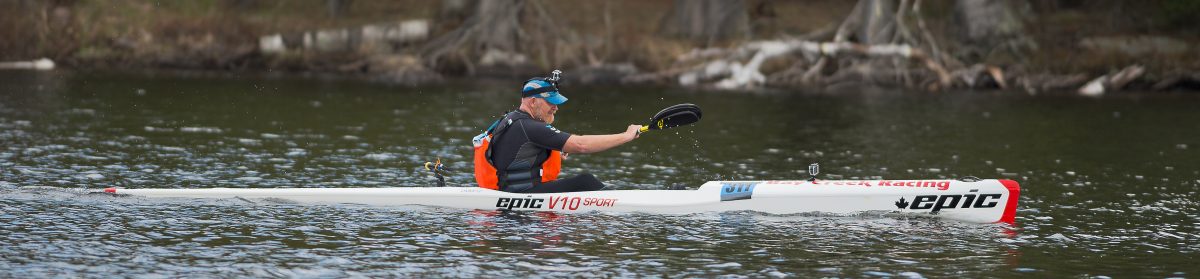
Because AB is so flat, I elected to paddle my V12. I’m not 100% sure I’m faster in it on the flat – I’m definitely slower in it in any sort of waves, but I think I have a small edge in these conditions.
Also, because of the humidity, I elected to not wear my PFD, which necessitated a change to my drinking system. With the PFD, I keep the water bag on my back, with the drinking hose snaked through the straps of the PFD and dangling on my chest where it is easy to grab it and stuff it in my mouth without losing more than one stroke. In my V10 Sport there is a perfect spot for the drinking bag ahead of the footplate in the cockpit, but it’s a very tight squeeze in the V12 cockpit because of this stupid ledge that Epic put in for no discernable reason. If I’d been thinking clearer, I’d have remembered that previous times I’ve paddled the V12 without wearing my PFD I’ve put the bag under the bungees on the back deck. I should have done that this time.
So when it was time to warm up, I started up my two GoPros. Nothing seemed amiss except the one on the front of the boat seemed a bit askew. After a few minutes warm-up, I discovered my drinking hose must be kinked because I wasn’t getting any water out of it. I stopped at the GRC dock and adjusted both the hose and the GoPro. However, the GoPro then decided to beep and announce it was missing an SD card. I have never forgotten the SD card before, so I assumed it was a glitch and power cycled it. No luck. So with no time to put it away somewhere, I left it on the front of the boat.
One aside – the GoPro Hero 5 Session that I wear on my head sometimes shuts off in the middle of a paddling workout for reasons I don’t understand. Hitting the record button on top starts it up, and it’s usually so quick I can easily cover up the glitch in the edit.
As I was lining up for the start, trying to make sure I was close to Eric, I heard the characteristic beeps of a GoPro shutting down. Thinking it was the one on my head, I quickly hit the record button on it. In retrospect, it was probably the one on the front of my boat deciding it had been on standby long enough and shutting down. So GoPro #1 shut down and I reacted by shutting down GoPro #2. That’s like the classic Cockpit Resource Management lesson about the airliner that crashed in the British Midlands because the pilot shut down the wrong engine when one was losing power. So there won’t be any video for this race. My adoring fans will just have to wait until the next race.
So anyway, the start siren went off and we launched from the line. We had the current and wind behind us, making for a fast first segment. Immediately Jim went off like a bullet, followed by John H and Royal. Todd wasn’t immediately up there but he came through pretty quickly. Eric got a good jump on me as I struggled for a few seconds in all the boat wakes, and Roger was right beside me. I put in a big pull to get up to Eric’s wake. I didn’t turn to look because of my lack of stability, but I assume Roger was now on my stern wake.
I wasn’t on Eric’s wake for long when he suddenly stopped to deal with his drink hose that was sort of falling out of his boat. I’m not sure if that was a ploy to get me to pull or a legit problem, but the upshot was that now I was pulling and Eric was on my side wake. I did a very quick glance and I could see somebody in a white boat on Eric’s stern wake, but I couldn’t tell you if it was Roger or Aaron (more about Aaron later). He stayed on my side wake for a while, but I suddenly felt like he was slipping back. I put in a dig and tried to scrape him on a canal buoy. It worked and he wasn’t on my side wake anymore. I don’t know if he was on my stern wake or not.
At the bottom turn buoy, I could spare a very short glance back and see there was more than Roger and Eric behind me. I couldn’t see who else was there, but there was one other boat right there, and several close enough to be considered a legitimate threat. I rounded the buoy and went for the wall, which is optimally shadowed from the current and the wind. And I immediately grabbed my drink hose and shoved it in my mouth and sucked, only to find nothing coming out! Dammit, kinked again! This is going to be a problem, I thought.
Half a kilometer from the turnaround there’s a point where you have to leave the shelter of the canal wall and move out because it gets shallow and weedy. That’s when I realized that instead of Roger or Eric, the occasional paddle banging noise I’d heard behind me since the turn was Aaron B, a local young sprint paddler. He was now up beside me on my side wake. Since he was obviously more stable in his ICF sprint boat than I was in my V12, I asked him how far back the others were. He said they were 5 meters behind. Well, 5 meters is better than nothing, so I kept grinding. I knew they could close 5 meters in no time if I tried any tricks to get Aaron to lead or tried to give another pull on my drink hose, and I didn’t want that. Better to tow Aaron than end up towing Eric and Roger.
For the entire way upstream, I was using every trick I could to get out of the wind and the current. I’d paddled the course a few times and I knew which tree branches you could duck under and which you had to go around, and I knew about one island you could sneak behind and the other one that wasn’t an island anymore. I also made use of the wakes of canoes we were passing to get a bit of a launch. But here’s the weird thing – when I used one of these tricks, Aaron would leave my stern wake and go paddle in the middle of the river, still keeping up with me. I got the distinct impression he was toying with me. And because he’s young and fit, I assumed it was only a matter of time before he got bored of that and blasted off ahead.
I was actually kind of counting on him blasting off ahead. By the second turn buoy, my cockpit had an annoying amount of water in it, but I didn’t want to kick open the venturi drain because of the extra drag. I figured he’d blast off after the turn, I would be able to assess where I was ahead of Roger and Eric, and see if I had time to deal with the venturi drain and maybe even make another attempt at getting something out of my drink bag. But he never did, so I never did.
The second turn buoy is the best place for assessing where you are in the race. I was a little surprised to see Todd coming downstream before Jim. After Jim, John H was very close to him, but Royal looked like he’d be well and truly distanced.
I had a pretty substantial gap on Eric and Roger, who were still together. Not very far behind them was Dennis, a local triathlete who started paddling with us last year and who is making rapid progress to becoming a fast paddler. Further back was a clump of paddlers that contained Jim P, Steve B, Mike F and Mark, another local triathlete who is making the transition to paddling. It was kind of weird to see Jim leading because he put a heavy weight belt into the bottom of his boat to give himself more stability. His boat must have weighed 1.5 times as much as the Ultra layup boats of Mike and Steve. Steve B called something to his son Aaron – I think he was asking if Aaron was feeling ok, and Aaron said he was fine. So suspicion confirmed – he wasn’t having a bad day, he was toying with me.
Ok, I thought, he’s going to outsprint me. Big deal, that’s his specialty. He can probably hit 15 km/hr in a sprint, whereas I’d be lucky to hit 12 km/hr for more than a few seconds. But I kept grinding away because I knew if I didn’t, Eric was going to grind right back up to me. Aaron would be on my stern, then out a boat length or more off to my side, then he’d be back on my stern. I really had no idea where anybody else was – I couldn’t see the kayakers ahead of me through the forest of canoes, and I couldn’t hear or see anybody behind me except Aaron.
At all the landmarks where I knew how far to the finish, I expected Aaron to sprint past me. Under the 490 bridge, 600 meters to go, no Aaron. I tried to raise my speed as much as I could. Under the pedestrian bridge, 300 meters to go, still no Aaron. Ok, this is weird. He should be able to pass me in his sleep. But he didn’t. As I crossed the line, they called out our finish times, and I was a few seconds ahead. So he didn’t even pull up even. By the time I got to the dock, I could see Eric and Roger had finished not very far behind me. But the important thing was they were behind me. I think I heard somewhere that Roger actually passed Eric, but I’m not sure about that.
In terms of actual time and speed, this was actually my slowest AB since 2010. That’s a little worrisome, but I think the stronger than usual current and wind slowed me down a tad. Thanks to Royal and John H still being youngsters, I ended up finishing 3rd in my age group. I’ll take that.