First Class B experience, not as scary as I thought.

Vicki and I flew the Lance down to Pittsburgh to pick up Laura from college for the summer. It was my first experience with Class B. I was a little leery of the traffic in and out of KPIT, since it’s US Air’s hub, but Allegheny County Airport (KAGC) isn’t much further from the school and probably is a bit more GA friendly. As a side note, this is my first flight since I got my used Garmin 296.

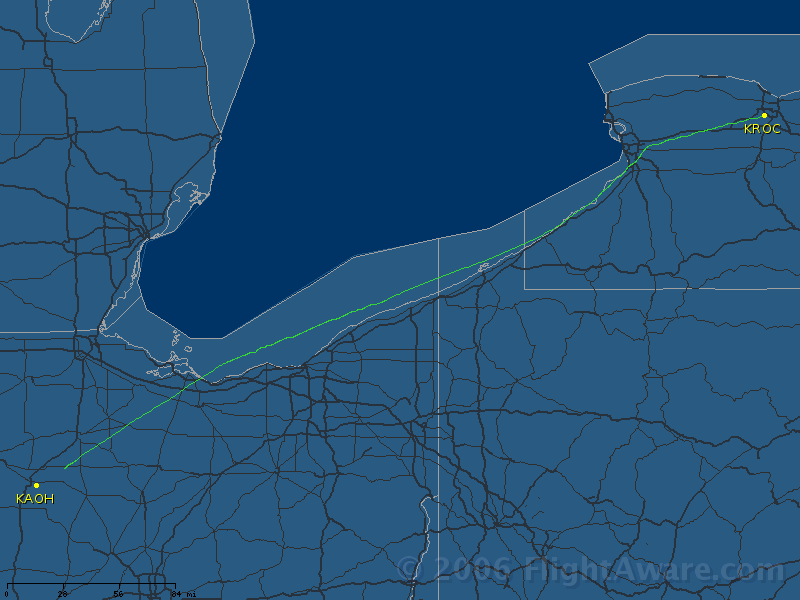
Down, as FiledI filed a nice airway route that took me around the Class B: KROC GEE v119 MILWO v12 FURIX KAGC.

Down As ClearedBut when I called for my clearance, I guess they figured “hey, it’s a beautiful CAVU (Ceiling and Visibility Unlimited) day and he’s probably got a handheld GPS”, and so they cleared me “KROC GEE KAGC”. Almost direct the whole way. And once I took off and contacted approach, they said “proceed direct KAGC”. With the GPS, it was easy as hell, and quite smooth up at 8,000 feet. The direct route took me into the class B – actually it was while I was on the descent to Allegheny County. The Pittsburgh controller was nice and friendly, and a lot more relaxed sounding than some of the New York area controllers I’ve heard.

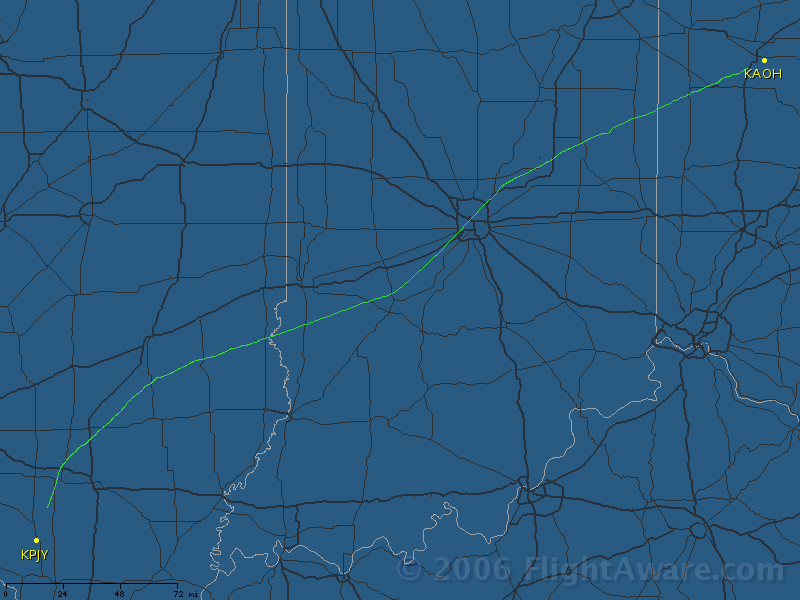
To As FiledFor the flight home, I filed pretty much the same thing I’d filed for the way down, but the Allegheny Four departure is a vector procedure, and CIP is one of the fixes in the depature and on v119, so I filed KAGC CIP v119 GEE KROC.

To As ClearedThe clearance I got was quite unexpected. It was KAGC ALLEGHENY FOUR EWC 050 ZORBO BAF v119 GEE KROC. It took me a bit of work to find ZORBO on the en-route chart, because it wasn’t on any airway. But after all the hassle of plotting this route on the en-route chart and putting it into the GPS, as soon as I contacted Pittsburgh departure they put me on a vector and then cleared me direct to BAF then as filed. Once again, it was very smooth up at cruising altitude (9,000 feet) but moderately turbulent down lower, both on the climb up and descent down.

All in all it was a fun trip.

Some answers on “Two Weeks To Taxi”

I wrote to Glasair about the plane I blogged about in Rants and Revelations » Now this is an intriguing idea. Here are some answers I got:

Q. When you say “two weeks to taxi”, what exactly is left before the plane is flying?

A. You will start up your engine and taxi your airplane while here. But, we recommend you do some simple steps for safety before you launch on your maiden flight. All you really need to do is a thorough safety inspection equivalent to a detailed annual inspection, weigh the airplane, complete your weight and balance calculations and then the last step is your FAA inspection, sign off to get your airworthiness certificate. Then you will start your flight test program.

We will provide you with all the detailed check lists for the final safety checks, W & B calculations and flight-testing.

Q. Do you provide familiarization training in the aircraft?

A. You will receive several hours of transition training included with the purchase of the airplane and the program.

Q. What about floats? Do you sell them as well? Can they be added there at the customer build center?

A. We do not sell floats, but we can refer you to a couple companies that make a float that will work well on the Sportsman. We cannot install floats in our program but we can put some of the attachment fittings on while you are here should you make a deal with one of the companies and they can get us the parts.

Q. I’m planning on going to Oshkosh. Is there any chance I could get a flight in a Sportsman, or just a look around one?

A. We will be at Oshkosh, and we invite you come to our booth and see the
airplane. However getting a demo flight there is not as good as getting one here at the factory. Because of the high density of traffic, we cannot allow you do to take offs and landings in that environment, and we simply do not have the time to go to another airport to get you that kind of demo flight. Additionally, we are so limited on the number of flights we can conduct, we try to limit them to people who are so close to making there decision to purchase, that it is the last thing they need to do before placing an order.

Therefore, we always recommend that prospective customers come visit us here at the factory. We are near Seattle. Not only will you be able to fly in a more relaxed atmosphere, but you will also have the opportunity to tour our facilities, and see that we are a substantial and credible company that delivers on our promises.

We are even willing to contribute toward the expense of coming to visit should you place and order with us.

I don’t know about you, but I’m convinced. Where do I mail my deposit?

(Just kidding, Vicki.)

Now this is an intriguing idea

For a long time I’ve looked at and rejected kit planes – they are a great way to get a very capable new airplane for a relatively low cost, but by the same token they’re also a hell of a lot of work and it seems like anybody I’ve talked to who has built one has spent years on it, even if it’s the only leisure time activity they did for those years (and consequently they end up with the test flight being the first time they’ve flown a plane in X years, which isn’t good). Add to that my lack of work space, and a little anxiety that I might do something wrong in a crucial and hidden part of the aircraft (like I did in the canoe I built all those years ago) and it didn’t really look like a good option for me.

Enter Glasair Aviation’s Sportsman 2+2. Here’s a plane that is equally at home on tricycle gear, tail wheel gear (and tundra tires if you want to get out to the boonies) and floats. It’s basically a 2 person plus a lot of gear plane, although they have optional back seats. The specs and reviews look very impressive. But it’s still a kit. So why the change of heart?

“Two weeks to Taxi”. That’s why. You buy the kit (and it includes everything from the engine to the tires), and you go to their “Customer Assembly Center”, and after two weeks of intensive hard work, you have a plane that you can taxi out of their hangar. I’m not sure what else is requried to fly, but the pictures in the brochure make it look so complete that it might just be a matter of painting and getting FAA approval. During that two weeks, you’re working with their factory experts there to help, and to make sure you don’t fuck it up. Plus you’re using their space, their tools, and their jigs. Not only that, but because you’ve got a better than normal chance of getting a plane built and flyable, the finance companies are more likely to want to lend you money.

Now I don’t have the money to run out tomorrow and buy this kit, so I’m sure other kit builders will be offering a similar program by the time I’m ready. But in the meantime, I’ve got this as my goal to aim at. So now my three pronged goals for the next year or two:

  • Become a more proficient pilot, especially in using the rudder.
  • Get float training.
  • Start a kit plane fund. Maybe I can start to put all my overtime money in it.

I can’t wait to talk to these guys at Oshkosh. Maybe I can cadge a test flight out of them.

Blue sky dreaming

I’ve been dreaming about flying float planes for most of my life. Especially after sore knees and hips made it increasingly hard to reach the silent lakes of my youth via canoe and hiking boot. I always remember that time on a remote lake in Algonquin Park where a park ranger dropped into our lake in a deHavilland Beaver and paddled the plane ashore. He was there to set up some toilets at a new campsite that wasn’t on our map, but he stopped over to check our permit and make sure we weren’t cutting down live trees.

Since then, I’ve often thought how cool that would be, to fly a Beaver into a lake that was only known to a few paddlers, and after the engine stopped making pinging noise as it cooled down, just listening to the loons and the breeze in the trees. I got to experience some of that on the Alaska cruise as we stood on the float of our Beaver for a few minutes.

Vicki and I were talking about it the other day, and she suggested that when I retire (or it becomes impossible to find my sort of work anywhere outside of Asia), I could fly floats as a second career. A little research shows that there are a couple of hitches to that:

  • Nobody will hire a float plane pilot without hundreds if not thousands of hours of float time.
  • Nobody (with the possible exception of Twitchells Seaplane Base in Maine, but that’s a long way to go before starting your flight) will rent you a seaplane except with one of their instructors sitting beside you.
  • Probably most importantly: float plane flying is strenous work, since the customers will expect you to do all the loading and unloading and dock work.

But before I throw out the dream entirely, I did some more research, and some more dreaming. On the dreaming side, there is Georgian Bay Airways, which as well as initial and advanced float plane training, also has a Career Bush Pilot Program where you get 50 hours of training, including 1 in their Beaver. I wish I’d known about this when I was 20 years old – they hire one or two of the students from this program to be dock hands for the summer, and you’ll get some more time flying both their Cessna 180s and Beavers. They tell me that last year’s two dock hands got an additional 50 and 80 hours flying time.

But on the more pragmatic side, I’m probably not going to be able to do that. But I could at least get prepared – I need two things: a commercial rating and a float plane that I can put a lot of hours into. So I’m looking around to see if there are any other local pilots interested in a small partnership on some sort of float plane. I can’t afford one of my own, but I might be able to swing 1/2 or 1/4 of a sufficiently old Cessna 180 or similar. These new Light Sport Aircraft are tempting, but the only LSA ambhibian is a boat-hull flying boat rather than a float plane, and none of the commerical operators seem to use flying boats so I doubt the flying time would count for much. I’m not sure if I’d even fit in a CubCrafters Super Cub on floats.

Before I get the commercial, though, I’ve got to fly a lot more. I’ve got the minumum hours for the requirements, but frankly, I consider myself a safe pilot, but not a great pilot. I have always flown “good enough” instead of “as good as I possibly could get”. I just don’t fly enough, and because of that I don’t nail my airspeeds and altitudes, I don’t use the rudder enough, and I’m not totally smooth. But I know I can do that stuff with practice. So that’s my goal this year – to get 50 or more hours of flying, and some of that time going out to do real airwork to get more than just proficient at the normal Private Pilot maneuvers before I start thinking about learning the commercial maneuvers.

Overdid it a bit. Or a lot.

I went paddling today. This time I didn’t have anybody with me to moderate my paddling, so of course I went out too fast and went too far. I got to the point where Vicki and I turned back on the weekend, and it only took me about 20 minutes (Vicki and I took about an hour there and back). Just past there the creek doesn’t seem to get any narrower, but it gets very shallow except for a deep channel on the outside of curves, so the current gets very strong. Also, it gets pretty twisty with overhanging trees upstream from there, so you spend a lot of time pausing to read the river and sweeping on one side or the other.

That’s where I noticed something that I’d mentioned last year some time – sometimes when I’m going around the inside of a corner where it gets shallow, my wake will hit the bank and bounce back and push my stern out, helping me around the corner. Also on straightish sections, the boat seems to hunt around for the deep part – it’s hard to figure out exactly what’s going, but I think the wake is bouncing off the bottom or something.

There were a fair number of people out on the river, including three racing canoes hammering downstream in close formation. It was just that sort of day where you had to leave work early and enjoy it. As well as the canoes and kayaks, I saw my first swan of the season, plus it appears that the female redwing blackbirds have finally come to join their males. I also saw a couple of nests in the reeds – sort of basket-like and up high. I think they must be last year’s.

According to the Google Maps Pedometer, I went 4.3 miles, and it took me about an hour and five minutes. It took me about 35 minutes to get up to Browncroft Ave and 30 minutes to get back. I guess that shows how much I overdid it – in spite of the strong current I couldn’t go downstream much faster than I went up.

One strange thing – last time I paddled, I found a lump of dried blood on the side of my left leg and a small scab. My legs get a bit numb when I’m paddling, so it’s easy to imagine me cutting myself without noticing. This time, same thing. Dried blood in the same place, and some on the floor of the cockpit. I can’t tell if I re-cut myself or re-opened the same wound. I looked very hard to find something I could have cut myself on in the cockpit, and I can’t find it. I’m going to have to remember to put on a bandaid next time.

My elbows are throbbing now, but I’ve taken some Alieve and I’m hoping it will get better.