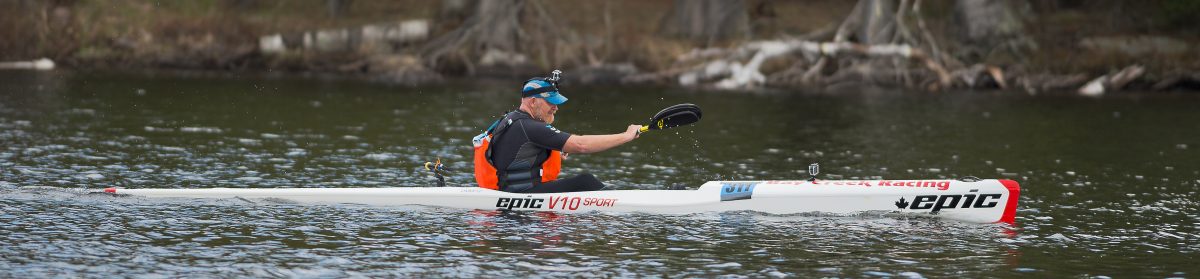
An ideal fitness device for kayak racing

I recently remarked to @GarminFitness that I wish they’d stop shrinking the displays of their Forerunners with each generation. Kayak racers are different from their main target audiences of runners, bikers and swimmers in that we don’t put the device on our wrists, we mount it on the boat. And therefore, smallness is a negative rather than a positive, especially for surf-skiers who usually stick it on our footstrap. A tiny display over a meter away from your face is really hard to read, especially for us older racers.

Garmin invited me to use their feedback form to suggest improvements. But before I do that, I want to figure out exactly what I want. And basically, it comes down to something the size of my old Forerunner 301, but with most of the guts of my Forerunner 310XT/910XT, and maybe some features borrowed from the 920XT.

In no particular order:

  • As big a display as feasible. When you configure the 310XT to display 3 data fields, the top one is just about the size I’d like everything to be. Ideally I’d like to have 4 data fields that size on the screen at a time. Some of the Edge GPSes are that size, but they appear to be only for cycling and I don’t know if they’re waterproof to IPX7 standards.
  • Make sure it’s compatible with polarized sunglasses! My iPhone is not. Neither are half the displays in my car. Is there something about making color displays that requires them to have a polarizing sheet? If so, I don’t want color!
  • When it flips between displays, don’t scroll the fields that aren’t changing. I currently have my 910XT set to have two 3-field displays, and my heart rate is the big top one in both. It would be nice if it stayed on the screen while the other two fields are flipping to the next.
  • Add support for multiple profiles that are tied to the activity list on Garmin Connect. I use the “Other” profile on my 910XT, but when I upload to Garmin Connect I need to change that to “Paddling”. Why can’t I make a “Paddling” profile on my Forerunner that will be “Paddling” when it uploads to Garmin Connect? Even better, allow a “Paddling Training” and “Paddling Racing” profile so I can get rid of the screens I don’t need during a race (like lap times and previous lap average speed).
  • The best feature of the 310XT/910XT over the 301 is that it charges and uploads without making a hole in the case. My second 301 succumbed to salt water when the USB port oxidized like crazy. So we definitely don’t want holes in the case.
  • Continue to support industry standard ANT+ heart rate monitors, even 3rd party ones. Perhaps add Bluetooth Low Energy support as well – my current heart rate monitor is a Wahoo TIKR, which does both.
  • And if you’re going to add Bluetooth Low Energy, tie it to my phone so it can upload live tracking the way the 920XT does. And then we don’t need that little dongle thingy tying up a USB port on our computers.
  • Keep the great battery life. I’ve tried using my iPhone instead of the Forerunner for workout tracking, and it sucks the battery down to nothing in a few hours. The Forerunner is still reporting 80% charged after that same amount of time. Because my Forerunner is mounted rather than on my wrist, I don’t care if you have to make it fat to give it better battery life.
  • If I load a course up, I’d like to have the course map added to the automatic cycling between screens. As a paddler, I can’t use my hands to do that the way a runner or cyclist can.
  • If I load a course up, I’d like to do a virtual “race” against the previous best time I’ve done that course. I suspect that’s there, but I’ve never figured out how to make it happen.
  • Can the current one be set up to start the timer as soon as you move without also making it stop timing if I stop for any reason? I don’t want to be pressing the start button when I should be paddling for all my worth, but there are legitimate reasons to stop moving in a paddling race that still count towards your time, like transitioning to portages or turning around a buoy. I’ve only found a feature to stop the timer whenever you stop, and that’s not what I want. If that’s not a feature yet, I’d like it.
  • Make the countdown beeps louder! I can barely hear the 5 second count downs at the end of a interval when doing a workout. That might be due to the foam block I mount it on, but it would be nice if it were louder.

Why do I do it?

I’m in the process of planning my trip out to British Columbia to participate in the Canadian Surfski Championships. And to see family. But as I’m trying to organize seeing family around my need to train and prepare for the race, I’m hit by the absurdity of it all. Why do I care so much about being properly trained and prepared for this race? It’s not like I’m going to win it. Based on my few experiences paddling against Canadians, I’m not even going to be in the top 50%. So why bother? Logic would indicate that I should forget about preparing, spend the entire week visiting family and accept whatever pathetic place I end up in the race and just enjoy being on the same race course as Sean Rice and other top level elite racers. But screw logic. I want to finish this race knowing that whether I come 30th or 300th that I did my very best.

There is very little logic to being an amateur non-elite athlete. I’m not going to win any money or fame or be recognized by people outside the sport. I’m not going to be the best paddler in the country – heck, I’m not even the best paddler in Rochester NY, and it’s likely I never will be. There are guys ahead of me I’ll never catch, and guys behind me who will never catch me. But there are also a few guys behind me who could catch me, and maybe one or two ahead I could still catch. And let’s just try not to think about how I’ve reached the point of my life where I’m going to have to work harder and harder to not slow down, a red queen’s race that everybody eventually loses. Not a lot to justify the hours and hours a week I spend training, the damage I’ve done to my body, or the resulting pain.

I’m not sure the elite guys would agree with me, but I feel like relative to our relative abilities, I train just as hard as them. I can put in a two hour paddle and be so wiped that I come home and fall asleep for a few hours. Tell me that isn’t as good as some elite guy who paddles more hours at faster speed, but is then able to function normally for the rest of the day? If I had the innate ability, youth, years of experience and a body not prone to chronic pain, wouldn’t I have been as fast as them? There’s no way to really answer that.

So if you want an answer to the question in the title, you’re not going to get it. And if you excuse me, I’m going to go upstairs and spend 70 minutes paddling to nowhere on my Speedstroke erg.

2015 Racing Calendar

Trying to figure out my racing calendar for 2015. Here’s what I’m thinking so far:

May 16th: Round the Mountain
June 4th-7th: TC Surfski Immersion Vacation
June 20th: Ride the Bull
July 18th: Canadian Surfski Championships
July 25th: Blackburn Challenge
August 8th: Armond Bassett
September 12th: Lighthouse To Lighthouse
September 19th: Baycreek Kayak and SUP Cup
September 26th: Long Lake Long Boat Regatta.

I’ll fill in more as I have other ideas. Still thinking I’d love to get a tandem surfski for some of these races, especially Blackburn and L2L.

A look back at 2014, and forward at 2015

As the 2014 kayaking season winds down, it seems like a good time to look back and forward.

First of all, the best news of all: my shoulder, while sometimes a little sore, no longer seems like it’s limiting my paddling. I have to take care of it, and I’ve adjusted my technique and my training to be more gentle on it, but these days it seems more sore when I’m not paddling than when I am.

Other highlights of this year:

  • Paddled 1516 kilometers (942 miles) so far this calendar year.
  • Set personal records in the Baycreek Wednesday Night Time Trial (smashing my previous best of 18:54 by going 17:36 on my first outing of the season), the Erie Canal Regatta (average pace is 0.5km/hr faster than last year), and just about every other race I did this year.
  • Participated in the Lighthouse to Lighthouse (L2L) race (the Eastern US Surf Ski Championships), my longest race so far (21.5km/13.4miles) and my first salt water race.
  • Participated in the TC Surfski Immersion Weekend and a clinic with Oscar Chalupski, which added to my week in Tarifa last year means I’m getting really confident in the waves.
  • Got a really beautiful new boat, a 2014 Epic V10 Sport Ultra. My old V10 Sport is sitting there lonely and unused – this one is lighter, fits better, and has a closable scupper drain, so what’s not to love?

Next year, I’m looking forward to more of the same. I’d like to get a bit faster on the flat, but what I really want is to get better in the waves. At L2L and other times I’ve noticed my speed drops way off when I’m getting hit by waves from two directions at once. So I guess I need to spend a bit more time in Irondequiot Bay, because that’s the best place in town to be constantly battered by boat wakes from every direction at once. And the reason I want to get better in the waves is that I want to do more ocean racing. I definitely plan to go back to L2L and hopefully break the top 25 this time. I also want to try the Blackburn Challenge, which is even longer (33km/20miles) and might present more wave and wake challenges.

I’m also planning to go back to the TC Surfski Immersion weekend. Unfortunately it looks like the finances won’t stretch to a trip to Tarifa.

Mike and I are talking about doing some doubles paddling. He has an ancient and heavy K2 kayak which he suggests we paddle and race and see how we get on, and if that works out, we should look to buy a double surf ski. Much as I’d like to support Baycreek, my local kayak shop and Epic dealer, the Epic V10 Double is both heavier and more expensive than the Stellar S2E, so we’re thinking of getting one of those from the dealer down in Ithaca, unless we can find something used on surfskiracing.org. I’ve seen a couple of likely ones there already, but unfortunately the price to ship them is upwards of $500 which makes a new one more enticing.

Erie Canal Regatta 2014

Last year at this race, Dan and Steve and I had started out together and then Dan and I had clashed our paddles together, Dan had dumped, Steve had briefly stopped to see if he was ok, and so my victory over them was tainted. I was determined not to let that happen again. I was going to beat them fair and square. Last year’s first and second place winners had stayed home, so our only other rival was Alan from Ithaca, the guy in the sprint boat who, at Armond Basset this year, had started off with Jim and blown up, and I’d passed him about 5 or 6 kilometers into it. I was hoping he’d do the same at this race.

Unlike last year’s Erie Canal Regatta, I was paddling my V10 Sport. It’s certainly lighter than my Think Legend, but the Legend is longer and narrower and possibly a little faster on flat water. I meant to do some side by side time trialling to determine which was faster, but I got busy preparing for Lighthouse to Lighthouse and never put in any time in the Legend. And when I did paddle the Legend, I dropped it on the dock and put a crack in it. So it’s off getting fixed, so like it or not, I was in the V10 Sport, paddling against two guys in V12s and one guy in an ICF sprint boat.

Unlike last year, we started upstream. As expected, Alan took off and opened a large gap. Dan said “just paddle smooth”, as per our game plan. Steve hung on Dan’s stern wash and contributed nothing while Dan and I swapped leads, being extremely careful not to clash paddles. We both picked up a leaf or two, but were able to bounce them off. We weren’t really gaining on Alan, but after the first kilometer I don’t think we were losing much either.

As we got close to the first turn, it looked like Alan wasn’t going to turn – we yelled to him and he apparently heard, because he turned around the “dolphin” (a term for those wooden pilings in the water that apparently I’m the only person who knows it) in the opposite direction (ccw) than we were set up for (cw), but he had enough of a lead that it didn’t cause a conflict. As we turned, I could see we’d completely dropped Steve – he was a dozen or more boat lengths behind. And we were hammering. Or rather I was hammering and Dan was hanging on. His turns in front were getting shorter and at one point he called out his heart rate at 165 while mine was 155. But I didn’t slack off because I really wanted to catch Alan. We did a few sub-5-minute kilometers and I could tell Dan wasn’t going to be able to hang on. I asked him if he had one more pull in him and he pulled for a few minutes, but then he dropped back onto my wake. The nice thing to do at that point would have been to slow down enough that Dan could catch his breath without slowing down too much so that we got caught. But I had the fire in my blood and my sights on that sprint boat, and it was getting closer and closer. And at about the 6.5 kilometer mark, Dan dropped off my wake and I was on my own.

As we reached the downstream marker bouy for the turn upriver, I was a about a boat length behind. Then he did a better job at turning, and so opened the gap up to three boat lengths. I clawed my way back, but just as I got into his wake, I got a leaf on my bow. Now a leaf in the bow is a constant hazard in the canal, especially in the fall, and it’s a very bad thing. A leaf on the can cost you a half a kilometer per hour at worst. Get a bunch, and it can be a full kilometer per hour. Get one on your rudder and it’s twice as bad, but thanks to Todd’s weed guard I haven’t had a problem with leaves on my rudder in a few weeks. Sometimes you can bounce the boat to shake off a leaf, sometimes you can knock them off by deliberately hitting a floating stick, and sometimes a boat wake will knock them off, but sometimes the only way to get them off is to backpaddle, which is not something you want to do in a race. Evidently this was one of those times. I tried numerous bounces, and we did hit a boat wake or two, but that leaf stayed stubbornly on my bow. And every time I left Alan’s wake to try to pass him, it felt like I’d opened a parachute. So I just stayed tucked into his stern wash. His speed kept going up and down – if his intention had been to drop me, it nearly worked. But I had seen similar variations in his speed when I’d been chasing him down river – it would seem like I wasn’t making any ground for a few minutes, and then I’d be catching him for a few minutes, and then he’d be back up around the same speed as me and so on. I found out afterwards that he doesn’t have a GPS and he’s just not very good at pacing himself when there’s nobody around him.

The problem with staying in his wake is that he was going straight up the middle of the canal – on my own, I would have been tucked in closer to the edges where the current isn’t as strong, and there might have been opportunities to find a floating twig or something to knock that damn leaf off. But it wasn’t to be – even when a boat came in the opposite direction, instead of moving closer into shore, he went out to the other side of the canal to let the boat by. And unlike many people you see paddling ICF boats, he didn’t get thrown off his stroke by the boat wakes, so my other hope, that I’d be able to pull past him, didn’t happen either.

I stuck in his wake up until the town of Fairport, but I knew that eventually I’d have to make some sort of move to pass him. At the Parker Street bridge I tried to pull out, but the leaf caused the brakes to come on, so I pulled back in. Then approaching the lift bridge I realized I was running out of time so I pulled out. And it was awful – I just didn’t have anything left. Instead of pulling up onto his side wake and challenging him for the win, I ended up losing a boat length or two. He got a well deserved win, and I got a pretty satisfactory second place. But I can’t help but think that without that leaf, I might have been able to do it.

Last year, on a slightly different, slightly longer course, but a possibly faster boat, I’d averaged 10.7km/hr or 5:36 min/km, and this year, in what was objectively the slowest boat of the top 4 finishers, I averaged 11.2km/hr or 5:21 min/km. And that’s something to be happy with.