I’ve had a security camera on the front door for a couple of years now, and as well as giving a bit of piece of mind at night, it’s also really handy during the day to watch out for delivery people. It was so successful, I decided I wanted another camera to watch the back door and the garage. That was motivated at least in part by the number of garage break-ins we’ve had in our neighborhood and the fact that at least one neighbor was able to give the police some nice pictures of the perp from his security camera.
Unfortunately the company that made the front camera (Airsight) had stopped selling them (it appears they’re back now), so I bought a Wancam camera. It had all the same features as the Airsight (Pan/Tilt/Zoom, controllable through any standard web browser, weather proof, infrared for night vision, motion detection, email, ftp, etc). I liked it at first, and the interface seemed very familiar but after a few weeks I noticed a problem – it needed rebooting at least four or five times a week. And since the power plug is in the garage, it often didn’t get rebooted for a few days, especially in winter. So it’s now sitting in my junk box.
I then bought another camera – I decided this time to get an HD, at least 720P. The camera I’m using up front has only one flaw major flaw – I wish it was better resolution. This one is a D-Link DCS-52222L. Unfortunately, because NewEgg.com’s search function sucks balls, I didn’t noticed that while I specified I wanted an outdoor camera, most of the ones the search returned, including this one, are indoor cameras. It turned out to be damn near perfect, except I’m sure any day now it’s going to succumb to the weather. Also I haven’t figured out how to get the motion detection working – I told it to email me snapshots but instead if emails me a text file.
In preparation for the inevitable, I bought another camera. This one, the Foscam FI9828W, advertised that it was “920p” (which is a non-existent resolution standard, but obviously somewhere between 720P and 1080P) and all the other stuff I wanted, like pan/tilt/zoom, weather proof, and most importantly, “viewable over the internet using standard browsers”.
Well, it turns out that that last one was a complete 100% lie. It only works on Internet Explorer and Firefox on Windows (and on Windows 10, it doesn’t work on the standard browser Edge, and you have to find the “Open in Internet Explorer” menu item) and supposedly on Macintosh. You have to install plugins to make it work, which means it won’t work on Edge and Chrome because they don’t accept plugins, and it won’t work on Linux because they don’t make plugins for it. Now on Linux I can display the actual video using vlc with a rtsp url, but I can’t control the camera. Also I’ve discovered that if I leave it up and running for a few hours, it’s likely to freeze up and then I have to re-open the stream in vlc. The only light at the end of this tunnel is I can view and control the camera with an iOS app. Not as good as just having a browser window open like I do with the Airsight and D-Link (and formerly the Wancam) cameras. Another thing that changes is that with the other three cameras, there was a simple “curl” command I could do to grab a snapshot from the camera. I had that running on my Raspberry Pi to grab snapshots every second and store them in case I needed to review. However, I did find a work-around using “aconv” – avconv -i rtsp://userid:password@192.168.1.16:88/videoMain -r 1 -vsync 1 -qscale 1 -frames 86400 -f image2 backcam%09d.jpg – unfortunately it’s too processor intensive and can’t run on the Raspberry Pi, so I have to run it on my desktop. Or I could have the camera take snapshots at regular intervals and FTP them to the Raspberry Pi. So I guess with these two work-arounds I have a functioning camera, although I’m not happy with it.
And if the blatant lie about “woks on standard browsers” wasn’t enough reason to hate them, here’s some other reasons:
The setup for daylight savings time is broken – if you enable daylight savings time, you have to choose the offset, but if you choose 60 minutes it changes the time by two hours, so you have to set it to 30 minutes to get it to offset by an hour.
I set up two video streams, with the “sub” stream being lower resolution one, but if you open the “sub” stream using rtsp in vlc, it actually still shows a full resolution stream. The secondary stream works on the D-Link
When you set up email, it asks for the sender and one or more recipients. But for some odd reason, it sends a copy of the email to the sender as well. So for the other cameras, I can use the camera name as the sender, but I can’t for this one because it has to be an existing email address.
When you set up ftp, you have to give an FTP url like ftp://192.168.1.4/uploads but if you give the trailing slash (like you would expect to do when you’re specifying a directory) it fails with a message that says the login credentials are wrong.
If you put the IR LEDs on “Automatic” mode, it doesn’t work. The IR stays off, and consequently the captured images are all black and the motion detection doesn’t work. If you want to see in the dark, you have to manually set it to “Night Mode” and remember to set it back off in the day.
So obviously whoever wrote the user interface was a moron.
Saturday was the Armond Bassett memorial race. I’ve done this race several times in the past, and up until now it’s only taken place in two weather conditions, torrential thunderstorms or hot, airless and humid. This year was a pleasant change – it was absolutely perfect – cool, overcast but not oppressively so, and with a slight breeze.
As usual I arrived way way early. The best part of any kayak race is the pre- and post-race hanging around with other paddlers and shooting the shit, and we had plenty of time for that. Because the race is in Rochester, not only did Vicki come to watch, two of our non-paddling friends Mike and Gail came to watch and cheer.
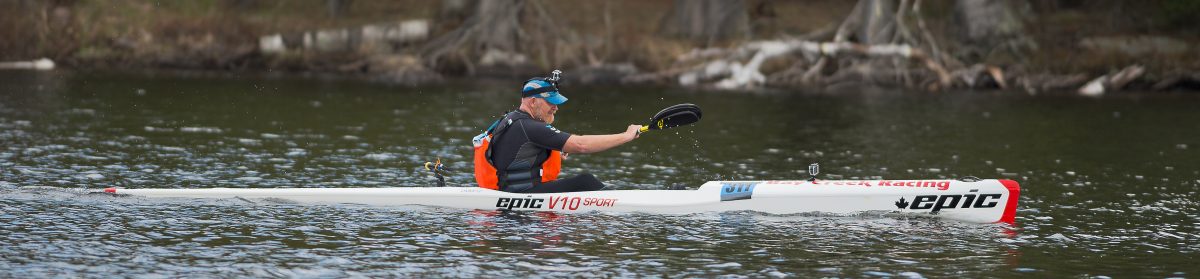
Since this race is flat water, I decided to try my V12. It’s not as light as the V10 Sport and based on my results in the weekly BayCreek time trials, possibly not as fast – although that might be because the time trial spends a greater proportion of its time making 180 degree turns and accelerating out of them. But it’s a boat I want to get some experience with and so I thought it was a good risk.
It’s also a course I scouted a few times, and there are some tricks to it. The biggest trick is that from about kilometer 1.5 to the turn at kilometer 3 the water is very shallow for almost 1/3rd of the width of the river to the left side, and again on the right after the turn. It’s easy to get suckered into that side because it’s closer to the inside of the curve of the river and so it looks shorter. But our long boats get slow in shallow water, and even worse you can find yourself dragging your paddle or your rudder in the mud and/or weeds. There are other shallow spots to watch out for, and interestingly enough, one place where sneaking in behind an island is actually faster because it’s surprisingly deep in there and sheltered from the current and wind. Oh yeah, one other factor in favor of the V12 – it has an over stern “kick up” rudder so I wouldn’t have to worry about weeds and submerged logs. I’d broken the rudder of my Sport on a submerged log while scouting the course a week or two ago.
At the start, as expected Tom Murn jumped out in front. He’s just back from competing in the Under 23 World Championships so while he’s been concentrating on 1000 meter sprints, a 16km paddle is just a walk in the park for him. He was followed closely by Todd who was followed closely by Doug and Mike in Doug’s V10 Double, and by John Hair, who was trying to get on the Double’s wake. That left Roger and I hunting for a wake we could hold, or failing that a good line. For some reason, everybody was going off to the left under the first arch of the first bridge. I knew that wasn’t as good a line but what are you going to do when that’s where the wakes are, so I followed. But even within the arch there were shallow spots and deep spots, so i was trying to hold to the deeper part on the right while Roger, who was to my right, was trying to push over to the left. I wasn’t yielding an inch and so he dropped behind me. It wasn’t until I felt a slam against the side of the rear of my boat that surprised the hell out of me and forced me to brace that I realized that roger had dropped behind so he could cut to my left. I guess he’d slightly misjudged it and hit my stern.
After we cleared the bridge, he and I were pretty much neck and neck and pretty much down the middle of the river until we got to the stretch at kilometer 1.5 or so. He got suckered into the shallows, and while it didn’t slow him down as much as I’d hoped, it must have cost him energy. He disappeared from view behind me about kilometer 2.5 or so. When I did the turn at kilometer three I could finally see where he was and he was at least five boat lengths back, and neck and neck with a stranger in a Simon River boat. That was enough of a gap for me to take a gulp of water, but not enough to stop worrying that either Roger or the stranger were coming back, or worse that they’d trade pulls and both pass me.
But now I was paying attention to John ahead of me. He had a pretty fair gap, but he was going into the shallows and losing time. Every time he passed a landmark I’d count how many strokes it took me to get to that landmark and I was definitely closing on him. I just had to hope I could catch him before he ran out of shallow water to make mistakes in.
At kilometer 6.5, we were back up to the start/finish area. My cheering section was easy to spot (and hear) as they stood up on the pedestrian bridge, although I couldn’t actually read the sign they were holding. It felt good to see them, and I feebly tried to croak out a thanks, but they couldn’t hear them.
Not too far after the bridge at kilometer 7 is a “sneak” behind an island. John didn’t take it and I did. I had a fantasy that I was going to pop out the other side of the island ahead of him, but that would have only happened if he’d gotten mired in the sandbar that tails back behind the island just under the surface of the water, but evidently he didn’t, because he was still ahead of me. I continued to grind my way up to him, keeping just enough further out from the shore that I wasn’t getting into the suck water and he was. Watching your GPS to see if your speed drops is a good way to do this – if you can trust the VIRB overlays on my video, you can see that I was still making a respectable 10.4 km/hr through the “sneak”, although I was closer to 10.7 in the deeper part of the river.
I didn’t actually catch John until about kilometer 10.7. I had time to take a drink and try to recover a bit in his stern wake, and while I was debating with myself whether to go up beside him and work together or just suck his wake as long as I could when he must have noticed me, because he suddenly made a sharp “S” turn. At first I thought he was avoiding a rock or submerged log, so I tried to turn with him, losing lots of speed in the process. But then he said something to me and put the hammer down, so I started to think he’d done it deliberately to throw me off, sort of like the “Crazy Ivan” move that Soviet subs did in “Hunt For Red October” and other military fiction. He claimed afterwards that he’d just turned to see what the noise he’d heard was, and was startled to see me there. I guess he was pretty focused ahead of him because there had been plenty of opportunities for him in the last 5 kilometers or so for him to see me in his peripheral vision as I was off his stern quarter.
At the turn at kilometer 11.3, he’d gapped me by a good four boat lengths, but my turn was a little better than his and I closed it to within two boat lengths or less. But no matter what I did, I just couldn’t seem to pop up that last couple of boat lengths to be able to ride his wake. For the rest of the way downstream, he’d get out into the middle of the river and open up a larger gap, and then he’d go to close into shore around a bend and I’d close it down a ways, and then he’d be out in the middle and open it up again. I don’t think I ever got closer than 2 or 3 boat lengths the whole way.
At kilometer 15.8, I passed under the pedestrian bridge again and once again my cheering section was waiting. I was too tired to do anything to acknowledge them other than look up at them and nod. But I was sprinting for all I was worth, and that isn’t much. I managed to finish 12 seconds behind John, which I’m pretty happy with. I don’t think I could have finished that close to him without the advantages of guile and knowing the river.
Last weekend was the Blackburn Challenge, a twenty mile race starting and finishing in Gloucester MA. Several of my team mates have done it multiple times in the past and they’ve told me it’s always no worse than anything we’ve paddled on Lake Ontario. It starts up a river, and then goes around the island that Gloucester is located on, then comes back into the harbor to finish a short distance away from the start. Looking at the map, the part out on the ocean looks roughly like three equal legs traveling roughly north east, then south east, then north west, like three sides of a square. And frankly from the stories I’d heard, I was more worried about the finish stretch in the harbor, where tired from the previous 18 miles you spend two miles dodging the wakes from crab boats and trying not to snag your rudder on a lobster pot bouy line.
I’ve done a lot of long distance training this year in preparation for this race. In most years, a ten or twelve mile paddle was considered very long, but this year that’s just getting started. I did a whole bunch of twenty mile paddles, mostly starting on Irondequoit bay and heading out on the lake to get a combination of swell and boat wakes.
So on the morning of the race, I checked the marine forecast, and it said a north east wind, with two foot swells. There was also a warning in the fine print that there could be waves up to twice as high as the swells in places. Ok, that’s not great, because it means that the south east leg will be with big beam seas. I hate beam seas. But it didn’t sound any alarm bells.
It was when we went to the school that the alarm bells started to sound. A guy who has done all 29 Blackburn races said he’s never seen it have a north east wind before. Another person said that the wind was stronger than forecast. The race organizer said that they were seeing four foot waves right where the river comes out to the ocean. Oh, none of this sounds good. But I’ve got my pfd, my whistle, my leg leash, and the race director’s phone number saved as a “favorite” in my phone. I’m good to go.
The race started like so many others, with lots of maneuvering around trying to find a good wake to ride and a good line through the bouys and boats. After being squeezed out from Pete’s wake when he threaded the needle between two closely packed boats I found myself riding the wake of somebody I was just thinking of as “the Hawaiian girl”, because she had the skin color I associate with Hawaiians and Polynesians. (I found out after the race that yes, she is Hawaiian and she won the women’s race.). She was setting a nice pace and we were passing lots of people, both from our wave and from previous waves. As we passed a sea kayaker he harrumphed “letting her do all the work?” And I smugly replied “yup, that’s racing”.
The mouth of the river got rough, but I was still hanging onto her wake. For about a hundred yards, then we were in the ocean proper. Suddenly we were going into waves that were at least four feet high. If you were down in the trough, you couldn’t see anybody ahead of you unless they were in the same trough as you. When you were up on the crest, you could see carnage. Every time you came up on a crest, you could see people in the water. You could also see waves exploding on the rocks to your right, and whitecaps breaking to your left. I was trying to stay somewhere in between. “Hawaiian girl” was long gone – it’s almost like she paddles on the ocean all the time or something. Pete came up and I tried to paddle with him, and we were staying pretty much together. The waves were mostly about four feet, although the occasional rogue would be bigger. Every now and then a big boat wake would come from another direction to add to the problems. Keeping together with another person in these conditions is all about moral support – you’re not riding each other’s wake in this shit.
After a bit, I dumped. Mild panic for a second because my new water shoes are bigger than my old ones and I never loosened the straps, so I was hanging in the water unable to get my feet out. But they came out after a few seconds. Pete asked me if I needed help but I’ve got confidence in my remount so I tell him to keep going – I figure I’ll be up and paddling again in a few seconds and I’ll be able to catch him. But my first remount attempt sucked and I fell in immediately. For my second attempt I remembered to wait for the crest of the wave to pass, and I think I got in properly. Meanwhile more people came by asking if I needed help. I don’t know if they were just really nice, or if they were just looking for an excuse to stop racing. If it had been me, it probably would have been the latter. Anyway, after remounting I took off after Pete with my leg leash wrapped around my leg and my drinking tube inaccessibly trapped under my feet.
A few minutes later I nearly caught him. I was not enjoying things at all because every wave was either one of those ones where your bow slams down into the wave after the crest passes, or water comes rushing in and floods the cockpit, or both. I was trying to take the bigger ones diagonally to reduce the slamming but it wasn’t helping. And through it all, I knew that after five miles of this crap, I’d have six or seven miles of beam seas just as bad if not worse. Have I mentioned how much I hate beam seas? I muttered to myself about this not being fun a few times.
Then I dumped again. This time my leg leash got wrapped around my entire body. It took me three attempts to finally get up and paddling again, all while fending off people who would not take “no” for an answer when they asked you if you needed help. Because my water tube had been trapped before, I took the opportunity while I was floating in the water to have a good old suck on the water tube. By the time I got moving, I had a sea kayak and an OC-6 (six person outrigger canoe) circling me like vultures waiting for their chance to swoop in and rescue me. But after the second failed remount I’d already made up my mind: the conditions were too tough and my remount too bad to continue, and I should go back to the start and abandon the race.
Silly me, I thought that after smashing my way through gigantic waves for two miles that if I turned my back on them I’d actually have fun surfing them. But there was something about them – I don’t know if they were too close together or too fast or what, but I couldn’t seem to get a ride off any of them. I spent a lot of time with my cockpit full of water bracing for my life. Very soon after I turned a safety boat came by and asked me if I was ok, and asked for my number to report me as DNF. The amount of flotsam in the water was startling – lots of water bottles, but scarily enough, a single running shoe. I don’t think there was a foot in it.
The entrance to the river was the scariest thing I’ve ever paddled in. The waves were hitting me from three directions at once and my cockpit was completely full of water. I was probably taking a forward stroke about once every five seconds and bracing for all I was worth the rest of the time. But after a few minutes, I was through that and I was actually catching some waves and having fun surfing. I was catching a large sailboat that was coming in under power, and I attempted to hail him to find out if I was in the right channel but he wouldn’t put his phone down. But almost immediately after I passed him, two other surf skis caught me. We formed “Team Discretion Is The Better Part Of Valor” and paddled together back to through the start and to the finish. It was like a pleasant day on the canal back in Rochester. Even with the part where the boat wakes make a “wake laser” as they reflect back and forth off of vertical walls, but here that was only a few meters instead of the 1.2 kilometers we have in Bushnells Basin.
After coming in to the finish, I lifted my boat and confidently trotted out to the parking lot where we’d left Mike’s car. Except it wasn’t there. It took me a bit to realize that if Liz had taken the car, she must be off retrieving Mike from somewhere. So I left my boat in the grass and was heading back to the finish when I ran into Mike and Liz. Mike had abandoned about the same place as me, but had gone into a cove called “diamond cove” or something like that instead of handing back, and Liz had gone to retrieve him. So they had obviously lost our great parking spot. Mike and I carried my boat out to their new parking space that seemed like half way across town, and on the way back we saw a truck pulling in with a two person rowing shell that had snapped in three pieces. We heard afterwards that it had been suspended between two wave crests and collapsed in the middle. We also ran into the guy who had rowed 29 Blackburns who had turned back right at the mouth of the river after taking one look at the waves.
Back at the beach, some of the first paddlers were coming in. The winner was only a few minutes slower than he’d been the previous year, so I guess if you’re really good you’re really good in all conditions. The second place guy was paddling a Maurauder, which is like a faster and tipper version of my thunderbolt, which is a boat that I’d never paddle in waves because if you fell out you’d never get back in. Todd and John came in in pretty good time, although they both looked like they’d worked hard for it. Then we settled in to wait for Pete. It’s nearly two miles from where they come around the breakwall to the finish, so we had a long view of people as they came in and we were struggling to figure out how to pick out Pete until we suddenly remembered that Pete has white paddle blades. That was definitely a distinctive feature as most of us have black blades. So we waited…and waited…and waited. He eventually came in about an hour after we would have expected him in normal weather. He was completely spent – he said he’d dumped twenty or thirty times, and a video taken from somewhere on the course showed that his technique had completely fallen apart and he’d basically arm paddled his way around the course. Even worse, when we picked his boat out of the water, we discovered it had a massive amount of water in the hull – I estimate about thirty or more pounds worth, practically doubling the weight of the boat. We’re not sure if he developed a leak or if he’d just spent so much time with the boat upside down that it came in the vent hole. But massive kudos to him – I know I couldn’t have done thirty remounts and I need every iota of my technique to get around such a long course even in perfect conditions.
We later heard that forty four boats had turned back at that the point where the river first reaches the ocean. Counting them and the rest of us, about one third of all paddlers had DNFed. So I don’t feel so bad about abandoning. So maybe next year. I’m going to hope for more typical conditions but I’m also going to work on my remount.
I just discovered that Garmin VIRB Edit is available for non-VIRB video. I’ve been looking for a way to overlay data from my GPS onto the video and this might do the trick. I would like to see the same stuff on the movie that I’m looking at during the race, like speed, heart rate, distance and time. I downloaded it last night and did some playing around. It’s pretty rough edged – it’s even worse than iMovie in terms of getting into states that I have no idea how to get out of.
The biggest rough edge is that it won’t touch videos that have a name that ends with .mov, but if you rename them to .mp4 they load just fine. The second biggest is that if your camera breaks a recording session up into a bunch of different files, it will only apply the GPS data to one of them. So what I did last night was I
Appended all my movie clips into one big one in Quicktime
Exported that big one.
Renamed it from big.mov to big.mp4
Imported that into VIRB Edit
Exported my GPS data from Garmin Connect as a .GPX file
Imported that into VIRB Edit
Tried to sync the video file and the GPX data
Exported that file from VIRB Edit
Imported that file into iMovie and started editing
Unfortunately when I looked at it in iMovie, I realized the GPX data wasn’t synced exactly right. So I went back to VIRB Edit, and found that when I tried to fix the sync it instead just lost its mind and decided that I was going 0 mph with 0 heart beats for the entire movie. So I don’t know what to do about that except maybe throw the whole thing away and start again.
After Thursday’s downwind, I got a bit of advice on strategy. Evidently by going in close to Watts Point into the relatively calm water, I ended up too close to where the outflow from the river curves around and hits you from the side. I was advised to stay further out of from the point, and at first to aim towards the wharf where the big ships are loading instead heading directly to the channel where the finish is (Mamquam Blind Channel), and only cut over at the last moment. This strategy would supposedly mean you get a better ride down the second part of the Sound and also not spend too much time in the “Potato Patch” that gave me so much trouble on Thursday.
The schedule for Saturday was a bit of “hurry up and wait”. Packet pickup was scheduled for 9am at the O Siem Pavillion (which doesn’t appear on Google Maps, by the way), but they posted on Facebook at 8:30 using the words “set up” making me think they had set up and were ready. I drove down there and found they were actually still setting up. So I came back at 9. Then I had to apply my race numbers and sponsor stickers to my boat, and drop it off at Porteau Cove. Then I drove back to the hotel and hung around biting my fingernails. At noon, a bus ran from the O Siem to Porteau. There was very little parking at Porteau, and this was their way of making sure people didn’t park up there until after the race. There was some time for socializing with the other paddlers. I managed to introduce myself to Greg Barton (founder of Epic Kayaks, only American ever to win Olympic gold medals in sprint kayak, and old friend of Jim Mallory). Then there was a mandatory paddlers meeting, and then it was time to paddle over to the start area to warm up. Vicki and Mom came over to watch me set off but the start ended up not being in the same cove as the launch area so I guess they didn’t see me go.
Earlier in the day there were some grumbles that the wind wasn’t going to be high enough, but as seems to be the pattern in Squamish it built during the day and was blowing pretty well by race time. The organizer said after the race that we were lucky because it was high enough to be useful to the pros but low enough that there wasn’t massive carnage – as it was there were about 8 DNFs with the safety boats bringing in various people and their skis. If it had been higher winds, I likely would have been one of them.
The wind whips straight down Howe Sound at the top part. Howe Sound has a nearly 90 degree bend in it at about the halfway point in the race, which causes some interesting effects, first with rebounds off the rocks, and then on the second half of the race with the swell coming at an angle to you as it rebounds down the Sound while the wind is coming from another direction and kicking up some other waves at a different angle.
So at the start, we have to paddle exactly 90 degrees to the waves out to the Think Kayaks Hot spot. That sucked for me. I was convinced I was probably last until a guy right in front of me dumped. So yeah, not quite last.
After the hot spot, I turned downwind and started to get some good runs. Most of the waves were in the 3 foot range, but there were some 4 footers or higher. Looking down the sound was an awesome sight as there were boats spread out in front of me from one shore to the other for as far as the eye could see. As I caught and passed a guy in a V8, he was whooping and hollering every time he caught a run, which was slightly annoying at first but later I started to feel respect for his strength – he ended up winning the “18 foot” class, finishing about 50 seconds behind me. There was this woman just in front of me who I had finished slightly ahead of on the Tuesday night race, so I was holding out good hopes of catching her. I got a couple of good runs and thought I was going to do it, but she caught several runs that I didn’t and the next thing I know she’s at least a kilometer ahead of me. I did catch and pass a guy who as I was nearly catching him he suddenly veered 90 degrees in front of me and I had to swerve to miss him. I’ll be charitable and assume he veered because of things beyond his control. I completely lost sight of the woman from before.
As I got close to the point the only people I could see ahead of me were well inside of me towards the point, contrary to the advice I’d been given before. Maybe that’s because everybody else who knew the secret was already around the point, I don’t really know. I kind of hedged my bets, getting closer in than I’d planned but further out than I’d done on Thursday’s downwinder. And after I turned, I headed for the big wharf.
Staying further out actually seemed to be working because even though the water was showing distinct signs of “potato patch”, with a strong swell coming from about 45 degrees off my stern on the left, another coming from about directly to my right, and even some coming from directly in front of me, it wasn’t completely throwing me off. I wasn’t sure if it was the better line, or the distraction of competition, but I seemed to be handling it much better than I had on Thursday. But eventually I had to get over to the entrance to the channel, which meant going through the worst of the potato patch, as well as dodging kite surfers and boats coming out of the channel. And at almost exactly the same place as Thursday, I dumped. My remount was actually a bit better than Thursday’s because I didn’t catch my paddle under the boat. But as I was remounting, who should I get passed by but that same woman who’d been over a kilometer ahead of me at the halfway point. I can only think she must have taken a much worse line or dumped. I put down every last bit of energy I had, but I was unable to catch her and she ended up finishing about 30 seconds ahead of me.
Just looking at the results, you’d say I sucked. I was 60th out of 71 finishers and 4 DNFs. But on the other hand, I raced in conditions far more challenging than anything I’ve ever done before, and I managed to finish. I even managed to have some fun on some of the runs. So I’d say it was a success. I went to bed happy that night.