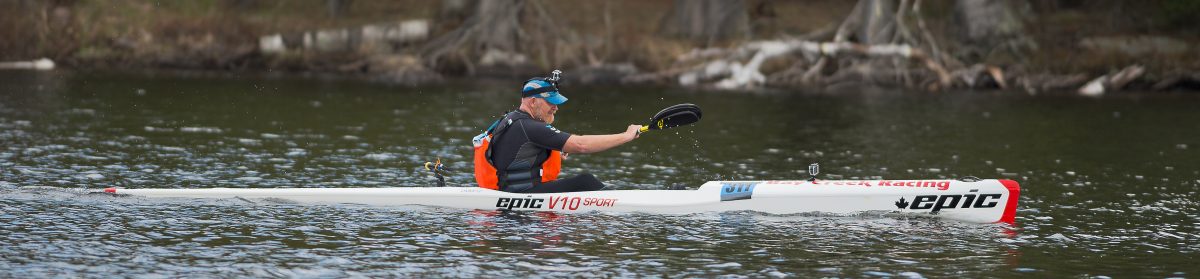
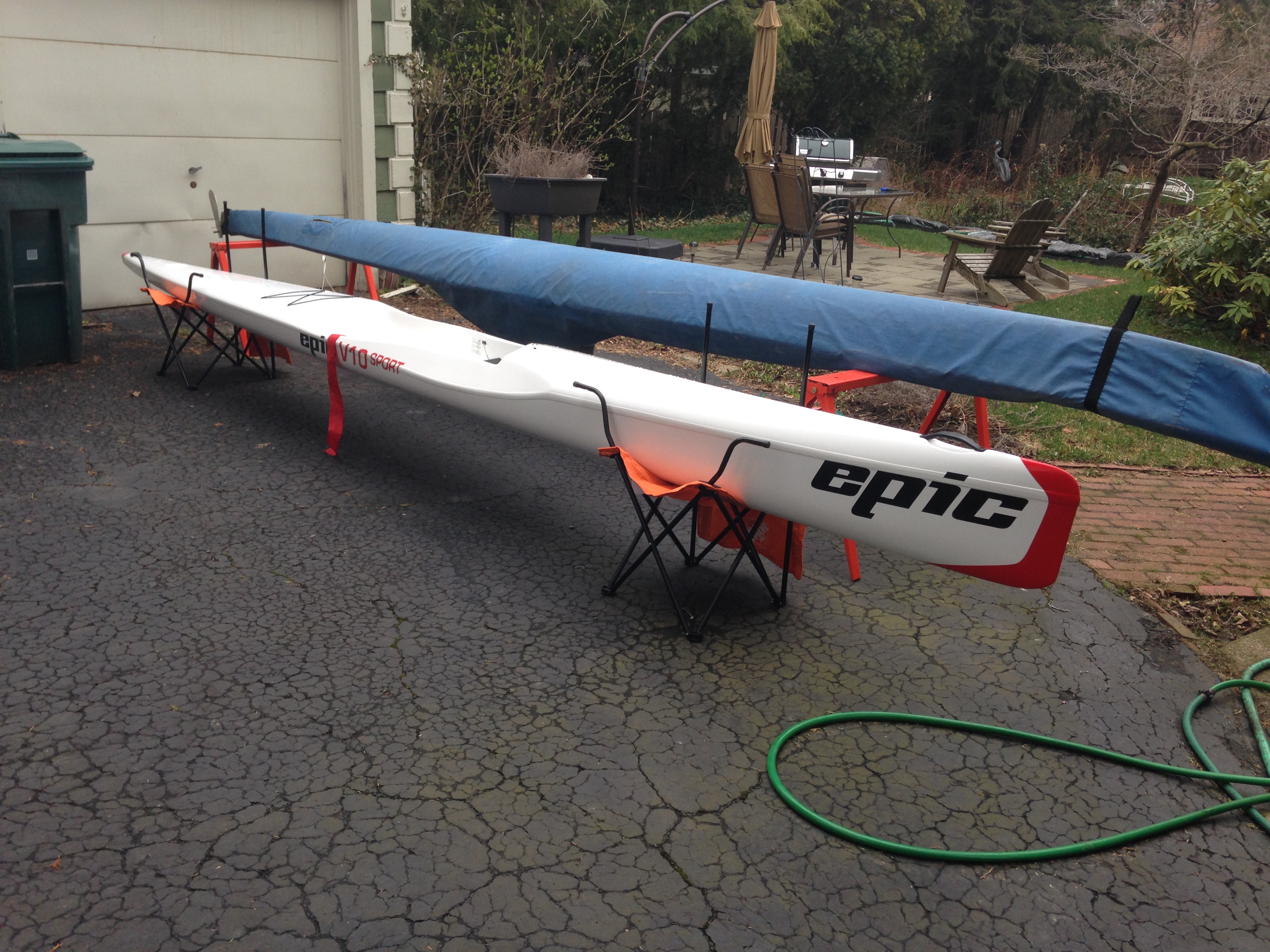
So today I did the Round the Mountain race for the second time. The first time was before my shoulder surgery, in 2010. Unlike that time, I’m not going to be posting a fancy map and link to my GPS and heart rate data, for reasons I’ll get into in a little while.
Just like in 2010, the weather was coolish, but fairly breezy. A warm up paddle out to the point confirmed that like 2010, there was going to be some tricky waves in the first lake. There was also going to be some quality people in the kayak classes. However the touring class kayaks (and the guide boats) were starting in the first wave, and I was starting in the second wave with the unlimited boats. That meant that unlike Long Lake last year, I wouldn’t have Roger Gocking as a rabbit to try to match, but Mike Littlejohn was there, and he was just as strong and powerful as he’d been then. There was some unknown quantities, including a guy in a Think Uno surf ski.
At the gun, it was the usual chaotic mess. Doug was on my right, and he yelled “There’s your ride, on your left” just as a C4 was heading past. I got on their side wake, but after a couple of times where I misjudged the way they swing back and forth I decided their stern wake would be safer. But just then we left the relative protection of Ampersand Bay and got into the windy part, and I guess the guy in the Uno wasn’t used to it because he suddenly veered between me and the C4 and across mine and Doug’s path. We both ended up t-boning him, and he actually grabbed my boat to stay upright, and we all came to a complete stop. He pushed on past and I put in a major effort to get back on that C4’s stern wake again.
I was getting a nice ride off their wake, and it was smoothing down some of the worst of the waves. And they were going pretty fast, although not catching Mike Littlejohn. They did catch a C2, and the C2 latched onto their side wake. They seemed to know each other and exchanged some words. I couldn’t hear much of what they were saying, but I saw what looked like a couple of references to me sitting pretty in the stern wake (well, “pretty” is perhaps not the right word when you’re staring at the stern guy’s butt crack…) I was worried that they were plotting how to scrape me off, so I gathered my strength and surged up between them, trying to get a bit of a launch from the two side wakes.
It worked, but I soon realized that the C2 had latched onto my stern wake and I was dragging him forward to another C2. When I caught that C2 I had a look back and the first C2 was still inches from my stern. And we still weren’t catching Mike L. We weren’t losing ground to him, either. In retrospect maybe I should have stayed for a longer rest. But I was sure I could catch Mike if I just worked hard enough now that we were out of the wind and waves. So I put on another burst of speed, and I look back and I’ve got both C2s now latched onto my stern like a pair of limpets.
Now we’re passing lots of people from the first wave. I dropped the two C2s pretty quickly once we got into the twisty stuff. Because the water is higher than it was in 2010, I’m taking lots of shortcuts nearer the shore and out of the marked channel, and I don’t think they were always willing to follow me.
The two guide boats are powering along, and I tried to give them a wide berth because it’s a twisty river and they don’t always go as straight as people who are facing forwards. I think I passed them just before or just after the bridge. Can’t remember exactly, except I was passing under a gigantic dead tree that was sort of halfway out into the channel when I passed the one who was in front. Whatever beefs I had against that guide boat who interfered with Roger at Long Lake last year, you’ve got to give props for how hard they work. That cannot be easy moving those big heavy boats backwards up a twisty channel with hidden logs and rocks everywhere.
Around the same time, I passed Mike Finear, and he started telling me about all the problems he’d had so far, including taking a wrong turn somewhere and running aground somewhere else, but I’m afraid I wasn’t in a mood to listen – I still thought I could catch Mike L, although it was becoming increasingly obvious that he was pulling away from me.
At the carry, there was a green K2 and a woman who was semi-blocking the way while telling everybody within the sound of her voice that she’d just had knee surgery and to be careful not to knock into her. I asked her if I could go by and I did, but half way up the hill there was some altercation which I didn’t see going on behind me with two guys in an identical green K2 and a guy in a kevlar C1. They were swearing at each other and threatening violence, and I stepped aside and let them go by, yelling after them “there isn’t any money on the line, why don’t you relax”. The guy with the C1 was trying to carry it up on top of his shoulder like a K1 (instead of on his shoulder like most people do) and he kept dropping it, which I’m sure didn’t help his mood. Fortunately he was trotting faster than me so even given the time he was wasting picking his boat up again I didn’t have to pass him and risk getting sworn at or worse.
On the way down the hill to the dock, I fell and hurt my back a bit. And then at the dock I tried to get into my boat from a high dock, which is not something I ever practice (I prefer to stand in the water and do a cowboy straddle, but there was somebody there already). I tipped and fell over into the freezing cold water. I quickly dumped out some of the water, but I think I left about 10-15 pounds of water in the boat. I also realized that my GPS wasn’t on the front of the boat anymore. Hoping that the foam block it was on would float, I did a draw to one side to look at where I’d dumped to see if the GPS was there, but somebody dropped a canoe in the water right there so I couldn’t see squat.
At this point Mike F was coming down the hill, and I realized I had the choice of getting back to shore to hunt for my GPS and give up on the race entirely, or I could finish with a semi-decent time and hope the GPS turned up afterwards. I elected for option B. I’d seen Mike L getting into his boat when I fell coming down the hill, so he hadn’t been that far ahead of me, but after dumping I realized it was going to take a miracle for me to even see him again. Especially since I was paddling without a GPS and with all that water in the bottom of the boat. And I wasn’t paddling well. The two C2s I’d left behind back in the early part of the stream had passed me, and I was starting to see other people I’d passed earlier – some I was re-passing after losing time to them at the portage and some who were passing me because they weren’t exhausted and rattled like I was.
About a kilometer or two from the portage I got my miracle. Mike L was standing on the shore dumping water out of his boat – he must have cut in too tight on that corner and hit a rock or stump and dumped. I thought I’d never have another opportunity like this so I tried to put on some more speed, but I really don’t think I did much. I so wish I had my GPS track to see if I really had increased my speed.
At one point in the rest of the race, I heard a little muffled beep and thought that maybe my GPS had floated into the inside of my boat and I was hearing it from down near my feet or something, but a few hundred meters later Mike L comes by and I realize his GPS is beeping at seemingly random times. I tried to keep on him, I really did. I buried myself, but I didn’t quite hang on, and I think I finished about a minute behind him. I was so disappointed. But I figure that if I hadn’t lost all that time at the portage from dumping, and if I hadn’t been paddling with all that water, and if he’d still given me that “gift” of dumping where he did, I probably would have held him off. But that’s a lot of “ifs”.
After the race, I asked Brian Mac, the organizer, if he could make an announcement asking if anybody saw my GPS, either at the dock or where I fell down on the hill. But instead he said “I’ve got a safety guy there, I’ll radio him”, and sure enough a little while later I got word that my GPS had been found and would be returned to me when the safety boat returns. And sure enough, it was returned, still running. The foam block it sits on was ruined – on of the two feet with the velcro had been torn right off – and I never heard if it was in the water or on the hill, but it sure was a relief to know that I got it back, especially since I only got the heart rate function working right this Monday.
So the take-away from all this is:
- I still suck at pacing myself.
- Mike Littlejohn is strong as an ox, and is a formidable paddler in spite of the fact that his technique isn’t great.
- I need to get faster.
- I need to work on my portaging skills.
- I’m sure glad I don’t get as hyper as those guys who were swearing at each other on the portage.
- I’m luckier than I have any right to be sometimes.