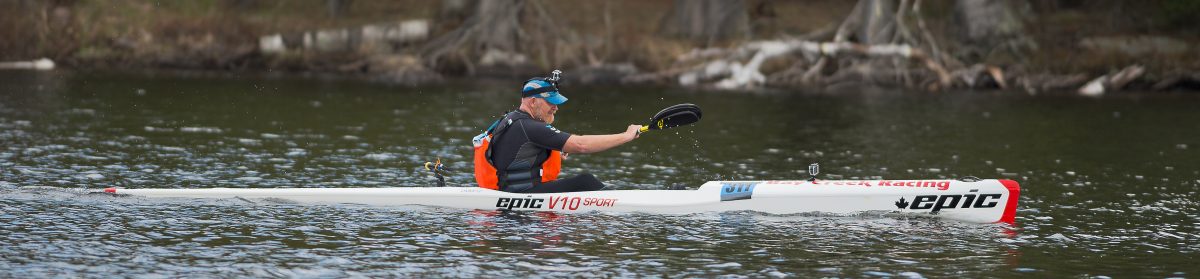
Close on the house, go kayaking

First I wrote the biggest check I’ve ever written in my life, and went to the bank to get a bank check for that amount. Then we went to the lawyer’s office to wear out a couple of pens signing and initialing several trees worth of paper.

Once that was over, I came home and went for a paddle. Without Vicki, so I paddled faster than I should have and took fewer rest stops. I tried to concentrate on making a good stroke without much elbow action, except when doing sweeps. I’m starting to feel a little twinge in my left elbow, so I’ll probably regret it tomorrow. There was a pretty brisk breeze blowing (the aviation weather report said gusting up to 19 knots), which was mostly acting opposite the stream, so paddling downwind and up river and then down river and into the wind, but the creek is twisty enough that sometimes I was fighting both stream and wind, and sometimes I was getting benefit from both.

I did the left fork up from the wier, which is a lot less used than the right fork, and much twistier and with a bunch of false creeks. Lots of paddling with the skeg up, maneuvering around, which probably isn’t so good for my elbows but quite fun.

At one point I coasted along a paddle’s length away from a Great Blue Heron whispering to it that I wasn’t a threat and it didn’t have to fly away. Another point I came around a corner and saw a 20 metre straight stretch of river with 5 geese poking their heads up out of the grass on the bank.

Peterborough Canoe

When I was a teen, one of the most important influences on my life and my personality was the time I spent at summer camp, at YMCA Camp Beausoliel, on Beausoliel Island in Georgian Bay. I think I went to this camp the first time when I was about 11, and went every summer until I was in the “senior cabin”, around 15 or 16 years old. The last time I went, I actually went for two or three straight terms instead of just one – when you’re there on the day in between the last batch leaving and the new batch arriving, you start to feel and act like one of the staff.

The most important part of every session at this camp was the canoe trip. The first time there I found it a little disorienting, because as soon as we arrived, we did the usual introductions to everybody in the cabin, and then we immediately started planning our menu for the trip. What did I know about planning menus for canoe trips? Not much. Neither did the other campers – so basically it was a monologue by the counsellor. The next day we had a lesson on basic paddling skills, and another lesson on basic wood craft, and the next day we set out on our trip. All the cabins from the 11 year olds to the 16 year olds set out on their trips that day. It must have been very quiet around the camp after that.

With 5 or 6 cabins full of boys setting out on simultaneous canoe trips, and a watercaft program for the more junior cabins, obviously the camp had a lot of canoes. All of them were wood and canvas except a couple of horrible wood and fiberglass canoes that nobody liked. There was a definite heirarchy of the canoes, and the heirarchy of cabins meant that the older you were, the more likely you were to do your trip in one of the Peterboroughs. A bit younger, and you might have had to muddle through with one of the Chesnuts. And the really young cabins ended up with Lakefields. To tell you the truth, I don’t think any of us knew the difference between the canoes, but all the staff fought over the Peterboroughs, and so that’s what we wanted too.

Peterboroughs were classic canoes, built in the glory days of classic canoe building in the 1920s and 30s, in (not too surprisingly) Peterborough Ontario. And when I was an active canoer, I always wanted one. Although, thanks to Bill Mason’s endorsement, I probably would have settled for a Chesnut. I built a “stripper” when I was in college, but even its racy lines and beautiful looks couldn’t still my desire for an old classic.

In the early 1990s, I was working on a contract job where I’d work for nothing for two months, and suddenly get a chunk of cash (with no tax taken out of it) – sometimes as much as $10,000. So I’d be practically starving maxing out my credit cards, and then suddenly I’d be flush with cash. And instead of budgetting for the next two months, I’d rush out and buy a bunch of stuff. One of the times when I was flush with cash, I saw an advert on Usenet. A woman in Kingston had a couple of Peterborough canoes that used to belong to the Royal Military College in Kingston, Ontario. I rushed down to look at them. All of them had been badly treated by the cadets – some had broken or missing boards, or badly done patches. worst of all, they’d slathered layers and layers of fiberglas over them. But they were Peterboroughs, and I was blind to the practicality, seeing only the possibilities of finally having one for myself. So I bought the one that seemed the least damaged – although in retrospect I probably should have taken the one that was more damaged, but which wasn’t missing the name plate.

I took my Peterborough home (and at the time I was living in a house I shared with other people, and didn’t have a proper wood shop). I bought some of those metal folding saw horses and a few tools. I figured the first thing to do would be to get the fiberglas off the outside and the horrible blue paint off the inside. I had it in my head that what I wanted to do was to strip it down to bare wood, and then give it a clear coat of ‘glas and epoxy resin, so rather than having the classic old (and hard to maintain) canvas, it would be durable but show the beauty of the underlying cedar. I got a lot of the fiberglas off – fortunately it was old and hadn’t adhered well to the underlying wood. Actually, it might have been applied on top of the old canvas – I don’t remember. But after working on it a bit, I discovered something I should have realized before I started: that with my bad knees, I can’t stand around a canoe project any more than I can run or ski. So I stopped working on it, and unfortunately the canoe has been sitting outside, unprotected, ever since.

Since we’re moving, I decided it’s time to finally get rid of this poor unfortunate mistreated canoe. I can’t stomach the thought of breaking it up for garbage. So I tried listing it as “free to good home” on the local Usenet forsale newsgroup, and the local paddler’s web forum. One person wrote to me to say that I should try the Wooden Canoe Heritage Association web site. So I did – I listed it this morning before I left for work, and in the next two hours I got 8 phone calls and emails. I guess I’m not the only person who fell in love with Peterboroughs.

Mailing lists moved.

I’m home helping Vicki recover from her surgery. It appears to have gone well, and she’s not needing me to do much to help her – I expected her to be lying in bed all weekend weakly quavering out “bring me a cup of water, please”, but instead she’s sitting in her usual chair tapping away on her iBook.

While I’m home, though, I took the opportunity to move all my Mailman mailing lists from my home server to my linode. It was incredibly simple, if a bit time consuming. For each list, I copied over the /var/lib/mailman/lists/listname directory and the /var/lib/mailman/archives/private/listname.mbox/listname.mbox file. Then I fixed the permissions with
chown -R list.list lists/listname archives/private/listname.mbox
and fixed the internal pointers and stuff using
withlist -l -r fix_url listname
Then I trimmed down the archives (I don’t have enough room on the linode for the whole thing) using
mbox-purge --before 2004-01-01 archives/private/listname.mbox/listname.mbox
and rebuilt the archives using
su list -c "/var/lib/mailman/bin/arch listname /var/lib/mailman/archives/private/listname.mbox/listname.mbox"
and regenerated the aliases with genaliases. Then I went back to my home machine and removed the mailing lists there and put all the mailing list addresses in /etc/postfix/relocated.

Easy as pie. And now I don’t have to worry that the mailing lists will be down while we’re moving.

Spring Update

Ah, Spring.

Last night Vicki and I went kayaking. It was great. Vicki used Baycreek’s new Hurricane Aquasports Tracer which looks like a really nice West Greenland style kayak, very similar lines to my Skerray or the Avocet she was using last year, but made of “Trylon” plastic using a new vacuum forming method. Surprisingly sharp bow for being plastic. So is my Skerray RMX, but Valley are famous for how good their rotomoulded kayaks are. We saw lots of geese, some guarding tiny fluffy goslings. Also saw swans, most of them in aggressive postures, swallows, red winged blackbirds, a flicker (which was a surprise) and a kingfisher (which was also a surprise). The river was fast, but not so high as to make the weir too challenging. The reeds are starting to come in, but they’re still low enough that we could see what was down the other branch when the creek diverged. We went pretty far, and my elbows aren’t that sore today.

As another highlight of spring, today was the first real mountain stage of the Giro D’Italia. It’s been great how the sprint stages have managed to avoid being “the Alessandro Petacchi show” that they were last year, but it’s good to be up to the part that matters, where the GC riders make or break. Basso did great today, and I was surprised to see Cunego lost ground to Simoni. I’m still mad that OLN TV isn’t covering it daily like they did last year. And the “live streaming” software only works on Windows and probably wouldn’t work through the company proxy server anyway, plus what’s the point without Phil Ligget and Paul Sherwin? It’s hard to get a real feel for what’s going on when all you’ve got is the web updates, but CyclingNews.com is doing a pretty good job.

And the third highlight is the Kodak Perigrine Falcons. I haven’t been following them as obsessively as I used to when I could compare notes with Maddy, but it’s good to see that they’ve hatched another 5 this year. Pigeons beware!