Archive for the ‘Older stuff’ Category

Ivan Basso’s performance on this year’s Giro d’Italia leave no doubt in my mind who the real inheritor of Lance Armstrong’s mantle is. It looks like he’s going to try for the impossible - back to back wins in the Giro and le Tour, and if anybody can do it, he can. In a way it amazes me that a team from Denmark of all places can be so dominant in the mountains, but Basso had much better support in the mountains in the Giro than Armstrong had in last year’s Tour. Last year it seemed that whenever there was a mountain stage after a flat one, Discovery would get caught flat footed when the peleton broke up, leaving Armstrong alone without support. But Basso always seemed to have another rider or two until the crux of the stage.

It’s not as good as watching it on TV, but I’ve been following the race thanks to live.cyclingnews.com, and when away from the computer, using their WAP equivalent on my Treo. I think next year I’m going to spring for the money and get OLN’s webcast version. I didn’t do it last year because it was just the bare tv feed with no commentary, and because it required a Windows computer. This year they seem to have added commentary, and it works on Macintosh computers, but I didn’t go for it because I wasn’t sure if it was worth the money. But I’ve spent more for less, so next year I think I’m going to try it.

Paris-Roubaix. The Hell Of The North. One of the most classic of the one day Spring Classics. Long stretches of “pave” (cobblestones) that test man and machine. You expect crashes and you expect upsets. And this one didn’t disappoint.

First you had race favourite and defending champion Tom Boonen isolated in a 15 man break-away with no team-mates, but all his big rivals there, including George Hincape who had two team-mates with him to help. Things were looking good for George Hincape, until suddenly you saw him sitting up with his hands not on the handlebars. Of course he crashed - you can’t ride no-hands on pave. Then they showed the replay and it was obvious that the reason he didn’t have his hands on the handlebars is that they’d broken off!

Then that leading group broke into chunks, and Boonen wasn’t in the lead group of one, or in the chasing group of 3 (which included Hincape’s two Discovery team-mates). But then another disaster for Discovery - a train crossing barrier dropped in between the single leader and the group of three. But they obviously had their eyes on the leader rather than the rulebook, because they went through the barrier. The race mashalls stopped the next group with Boonen, which is just as well because the second they stopped the train went through.

Boonen was fuming about the stop, but it was probably the best thing that happened to him in the race, because after the finish they disqualified the three who went through the barrier, and so Boonen ended up second.

Well, that’s bike racing.

This morning I watched NBC’s “The Great Race”, a recap of the men’s 4×10km relay at the Lillihammer Olympics. (It’s available on Google Video if you didn’t catch it, but it costs money and requires Windows to do so.

It was an extremely well done piece, although they didn’t show the famous bit where Dahle stopped and tried to force the Italian to go ahead of him, but he wouldn’t. At least I think that was in this race - maybe I’m thinking of the 4×10 at Salt Lake?

Anyway, I’m watching these guys race in brilliant sunshine, and it’s a similarly brilliantly sunny and cold day here. And I feel every movement - my muscles are twiching in time to them, and I can feel it, I can smell it, and I can taste it. I feel the fatigue, the joy, the accomplishment. I remember the way your lungs burn and your muscles work, I remember the way you could smell the humidity and temperature, see and feel the condition of the tracks, and adjust your stride accordingly. I remember seeing and feeling every little rut and bump in the track and trying to use it to your advantage. I remember that nifty little way you’d swing one of your poles forward when you switched from diagonal stride to double poling, and how cool it looked when others did it. I remember being in packs of skiers all in synch. I remember going out every weekend that there wasn’t a race and skiing 30 to 50 kilometers, and not thinking anything about it. I remember skiing in the rain, in bitter, bitter cold, in icy conditions, in slush, where there wasn’t any snow on the ground or when it was snowing so hard that you couldn’t see the next bend in the trail. And I remember doing it all because on those days when it was sunny and about -2C and your wax was good, there was no feeling in the world like it. It didn’t matter if you won or came in slower than your personal best, it was just great to be out there. The effort beforehand, and the soreness and tiredness afterwards, it was all worth it.

After the race, I started to cry. It was the worst cry I’ve had since I was in therapy, huge wracking sobs. And all because I realized that I’ll never have that feeling again.

When I was a young skier, just starting to enter ski races, there was a skier in my club named Karl. He was older, grey haired, and had started skiing in his home country (Germany, I think) when he was quite young. I was about 15, and he was probably in his mid to late 50s. He gave me advice and encouragement. The first year or two, he was well ahead of me in every race. Then I got a pair of real Peltonen racing skis instead of my heavy old Madshus light touring skis. They were light, they were fast, and they had three grooves in the tail that were supposed to break the suction on wet snow. They weren’t the most aggressive racing skis on the market, they weren’t even the most aggressive racing skis that Peltonen made. But they were mine. And the first race I skied in them, I cut a HUGE percentage off my previous best, and beat Karl by a small margin.

Karl became less and less of a factor in my later years, but I always thought that when I got to his age, I’d be enouraging young racers the same way. Between him and Jackrabbit Johannsen, I had enough role models to think that skiing was going to be part of my life for the rest of my life.

That was before the pain. And now I have to accept the fact that pain is going to be the defining element of the rest of my life, not skiing.

I am driving a car, I am not competing in the Tour de France. When travelling with other cars at the same speed, it is not necessary to peel off and go back to the back of the line occassionally for a rest. It’s not necessary to signal to the other cars that it’s their turn up front. When coming up to pass another car, it’s not necessary to pause behind him to catch my breath so that when I pass him I can blow past him so quickly that he’s not tempted to follow on my wheel. And I definitely should not be tossing my water bottle out the window at the feet of pedestrians. Oh, and those pedestrians aren’t holding that water bottle out for you, they’re just standing at the cross walk with a drink in their hand.

That is all.

Once again the organizers of the Tour managed to put the most exciting stages on the weekend. And once again Team Discovery, the supposed best team in the tour, managed to get caught flat footed on the first climbing day after a couple of flat days, just like last Friday. And once again, Lance Armstrong proved himself capable of answering any attacks from the other Big Men of the tour, and dishing it back.
Continue reading ‘Weekend Update’ »

That was the most amazing stage of the Tour de France I’ve seen in years. The peloton falling to peices, all the Big Men being shelled off the back, and Lance pulls up to Popovych and tells him to launch him, and Popovych destroys the three T-Mobile pretenders to the throne, and launches Lance. Five guys left at the front, and Lance sets the pace for a while, and goes to the back of the five to take a quick look, goes back to the front, raises the pace again and slowly kills Basso. Rassmussen, Valverde, Macebo? Who picked them to be up there with Armstrong?

Can Lance keep this up? Can any human challenge him?

I’ve been thinking more about who will lead the Discovery team next year. Obviously for the Discovery team, the consideration isn’t about what’s best for American cycling, it’s about what’s the best use of their advertising dollar and which will get them the most press. But US Postal and now Discovery have been doubly blessed by having an American team lead by an American rider who is winning, and winning big in the biggest race in the sport. A lot of American sponsors have come and gone because they weren’t able to field a winning team or because their wins weren’t being done by an American.

If it came down to having an American rider leading but not winning, or having an non-American rider leading and winning, I don’t think either of those is going to be good for American cycling or Discovery. So I think they’ve got to go with Hincape and hope that in the next two weeks he proves himself capable of leading and winning.

This time of year, I’m majorly enthralled by the Tour de France. I’m going to presume to explain a few things about professional cycle racing even though I’ve only been following it avidly for 7 years now (and a little less avidly back when one of the riders in the peleton was a guy I’d shared tips on preventing penile frostbite with). Some of this might be laughably wrong to people who are really into the sport, but it should be close enough for the rest of you.
Continue reading ‘A tale of two super domestiques’ »

Watching the Tour de France coverage the other day, a couple of riders were accidentally shown by the cameras on a “natural break” (normally they show something else when the riders stop to take care of the biological necessities), and Phil Ligget was talking about how the riders won’t attack when a rival is taking a “natural break”. Paul Sherwin said that when he was riding, there was one rider who frequently attacked at those situations, so one day when he was off his bike for a break, the other riders stole his bike and pushed it a few kilometers up the road before abandoning it in a ditch. The rider had to wait for his team car to give him a spare bike, and maybe learnt a bit of a lesson about pay-back.

Then Phil told a story about when he was racing, and there was a guy who used to sprint on ahead until he was out of sight of the peleton, and then he’d hide and wait, and rejoin the peleton, and then enjoy being sucked along as the peleton tried to chase down this break that they couldn’t seem to catch sight of. He said this would continue for a few minutes until somebody recognized him in the back of the peleton. I guess this was before the days of race radios.

Just a couple of amusing anecdotes to while away the days before the race begins in earnest, with the first mountain stage on Saturday.

It’s nice to see Lance in yellow again, though.

I have a theory about this year’s race. The two time trials in the early flat stages of the race make it seem like it was designed to make Lance and his team have to get yellow earlier than they like and force them to defend it. And then the fact that both Saturday and Sunday’s mountain stages have long downhills to the finish means that no matter what Lance does in the mountains, the other “big men” will have a chance to catch him back up for the finish. I think Tuesday stage with two 1st category climbs and a mountain top finish will be the one that really shows whether this is Lance Armstrong’s tour again.

When I was a teen, one of the most important influences on my life and my personality was the time I spent at summer camp, at YMCA Camp Beausoliel, on Beausoliel Island in Georgian Bay. I think I went to this camp the first time when I was about 11, and went every summer until I was in the “senior cabin”, around 15 or 16 years old. The last time I went, I actually went for two or three straight terms instead of just one - when you’re there on the day in between the last batch leaving and the new batch arriving, you start to feel and act like one of the staff.

The most important part of every session at this camp was the canoe trip. The first time there I found it a little disorienting, because as soon as we arrived, we did the usual introductions to everybody in the cabin, and then we immediately started planning our menu for the trip. What did I know about planning menus for canoe trips? Not much. Neither did the other campers - so basically it was a monologue by the counsellor. The next day we had a lesson on basic paddling skills, and another lesson on basic wood craft, and the next day we set out on our trip. All the cabins from the 11 year olds to the 16 year olds set out on their trips that day. It must have been very quiet around the camp after that.

With 5 or 6 cabins full of boys setting out on simultaneous canoe trips, and a watercaft program for the more junior cabins, obviously the camp had a lot of canoes. All of them were wood and canvas except a couple of horrible wood and fiberglass canoes that nobody liked. There was a definite heirarchy of the canoes, and the heirarchy of cabins meant that the older you were, the more likely you were to do your trip in one of the Peterboroughs. A bit younger, and you might have had to muddle through with one of the Chesnuts. And the really young cabins ended up with Lakefields. To tell you the truth, I don’t think any of us knew the difference between the canoes, but all the staff fought over the Peterboroughs, and so that’s what we wanted too.

Peterboroughs were classic canoes, built in the glory days of classic canoe building in the 1920s and 30s, in (not too surprisingly) Peterborough Ontario. And when I was an active canoer, I always wanted one. Although, thanks to Bill Mason’s endorsement, I probably would have settled for a Chesnut. I built a “stripper” when I was in college, but even its racy lines and beautiful looks couldn’t still my desire for an old classic.

In the early 1990s, I was working on a contract job where I’d work for nothing for two months, and suddenly get a chunk of cash (with no tax taken out of it) - sometimes as much as $10,000. So I’d be practically starving maxing out my credit cards, and then suddenly I’d be flush with cash. And instead of budgetting for the next two months, I’d rush out and buy a bunch of stuff. One of the times when I was flush with cash, I saw an advert on Usenet. A woman in Kingston had a couple of Peterborough canoes that used to belong to the Royal Military College in Kingston, Ontario. I rushed down to look at them. All of them had been badly treated by the cadets - some had broken or missing boards, or badly done patches. worst of all, they’d slathered layers and layers of fiberglas over them. But they were Peterboroughs, and I was blind to the practicality, seeing only the possibilities of finally having one for myself. So I bought the one that seemed the least damaged - although in retrospect I probably should have taken the one that was more damaged, but which wasn’t missing the name plate.

I took my Peterborough home (and at the time I was living in a house I shared with other people, and didn’t have a proper wood shop). I bought some of those metal folding saw horses and a few tools. I figured the first thing to do would be to get the fiberglas off the outside and the horrible blue paint off the inside. I had it in my head that what I wanted to do was to strip it down to bare wood, and then give it a clear coat of ‘glas and epoxy resin, so rather than having the classic old (and hard to maintain) canvas, it would be durable but show the beauty of the underlying cedar. I got a lot of the fiberglas off - fortunately it was old and hadn’t adhered well to the underlying wood. Actually, it might have been applied on top of the old canvas - I don’t remember. But after working on it a bit, I discovered something I should have realized before I started: that with my bad knees, I can’t stand around a canoe project any more than I can run or ski. So I stopped working on it, and unfortunately the canoe has been sitting outside, unprotected, ever since.

Since we’re moving, I decided it’s time to finally get rid of this poor unfortunate mistreated canoe. I can’t stomach the thought of breaking it up for garbage. So I tried listing it as “free to good home” on the local Usenet forsale newsgroup, and the local paddler’s web forum. One person wrote to me to say that I should try the Wooden Canoe Heritage Association web site. So I did - I listed it this morning before I left for work, and in the next two hours I got 8 phone calls and emails. I guess I’m not the only person who fell in love with Peterboroughs.

Ah, Spring.

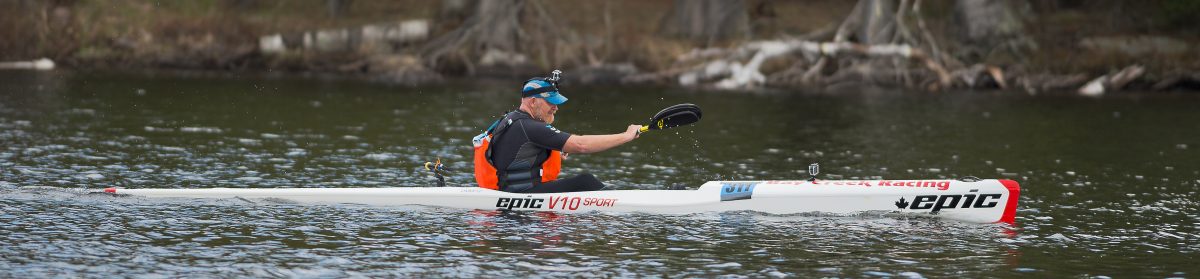
Last night Vicki and I went kayaking. It was great. Vicki used Baycreek’s new Hurricane Aquasports Tracer which looks like a really nice West Greenland style kayak, very similar lines to my Skerray or the Avocet she was using last year, but made of “Trylon” plastic using a new vacuum forming method. Surprisingly sharp bow for being plastic. So is my Skerray RMX, but Valley are famous for how good their rotomoulded kayaks are. We saw lots of geese, some guarding tiny fluffy goslings. Also saw swans, most of them in aggressive postures, swallows, red winged blackbirds, a flicker (which was a surprise) and a kingfisher (which was also a surprise). The river was fast, but not so high as to make the weir too challenging. The reeds are starting to come in, but they’re still low enough that we could see what was down the other branch when the creek diverged. We went pretty far, and my elbows aren’t that sore today.

As another highlight of spring, today was the first real mountain stage of the Giro D’Italia. It’s been great how the sprint stages have managed to avoid being “the Alessandro Petacchi show” that they were last year, but it’s good to be up to the part that matters, where the GC riders make or break. Basso did great today, and I was surprised to see Cunego lost ground to Simoni. I’m still mad that OLN TV isn’t covering it daily like they did last year. And the “live streaming” software only works on Windows and probably wouldn’t work through the company proxy server anyway, plus what’s the point without Phil Ligget and Paul Sherwin? It’s hard to get a real feel for what’s going on when all you’ve got is the web updates, but CyclingNews.com is doing a pretty good job.

And the third highlight is the Kodak Perigrine Falcons. I haven’t been following them as obsessively as I used to when I could compare notes with Maddy, but it’s good to see that they’ve hatched another 5 this year. Pigeons beware!

I registered for Blogger because I was sick of typing in my name and URL every time I commented on the Aviation In Canada blog. I put in my interests, and saw that one of the other people with “Orienteering” as an interest was named Tom Hollowell. That’s a name I remember quite vividly.
Continue reading ‘Blast from the past’ »

I don’t know why I get as excited about the road bike season as I do. As a rider, it was mountain bikes that I liked, not road bikes, and even there I only did one piddly little race before my knees started hurting. But the season’s started, at least as far as OLN TV’s coverage of it is concerned. And that’s a good thing.
Continue reading ‘Bike season’ »

One of my former cow-orkers at GeoVision just sent me this picture from one of our pick-up hockey games:

GeoHockey, as we called it, was a blast. I was terrible at it, but it got me a chance to get some exercise. The best part, though, was getting an ice-level view of some really good hockey players. There was one guy, Chris Fanjoy, who played in a couple of leagues, and because he played 4 or 5 times a week his equipment never dried out - you could smell him coming sometimes. There was another guy, dammit I forget his name, who just about danced on his skates - I remember just standing there in awe at what a fluid and natural skater he was. There were several other really good players, and watching them make plays gave you a sense of the game that I never got from watching it on TV.

There was another guy who I was always glad to see, because with him there I wasn’t the worst skater on the ice. He never changed his clothes - he skated in the same black jeans that he’d go to work in.

And there was a guy or two I was always sorry to see - they were good players, but they cared too much about scoring, and not enough about having fun. One of them would cuss me out for not having enough equipment after he’d broken the rules and raise the puck or after I’d limp off after he body checked me to the ground. We didn’t allow body checking or raising because this was supposed to be a fun thing, and some people didn’t have full equipment (namely cups).

We usually didn’t have goalies either - we just turned the nets around backwards and you had to bounce the puck off the back boards into the net to score.

Normally it was so much fun that it was worth the knee pain afterward.

Well, another Tour de France is over. And it was a great one.
Continue reading ‘Tour de France wrap up’ »